

A candle filter is an industrial pressure filtration system designed to separate suspended solids from liquids by passing the process fluid through multiple cylindrical filter elements installed inside a closed pressure vessel. Solids accumulate on the filter media, forming a filter cake that can be washed, dried, and discharged. Candle filters are particularly suitable for fine solid-liquid separation, catalyst recovery, chemical processing, and applications involving high-solids or valuable filter residues.
Unlike conventional cartridge filtration, which generally retains contaminants within or on disposable filter elements, a candle filter can use cake formation as an essential part of its separation mechanism. This makes it suitable for processes where recovering solids, reducing liquid losses, and maintaining a contained operating environment are important.
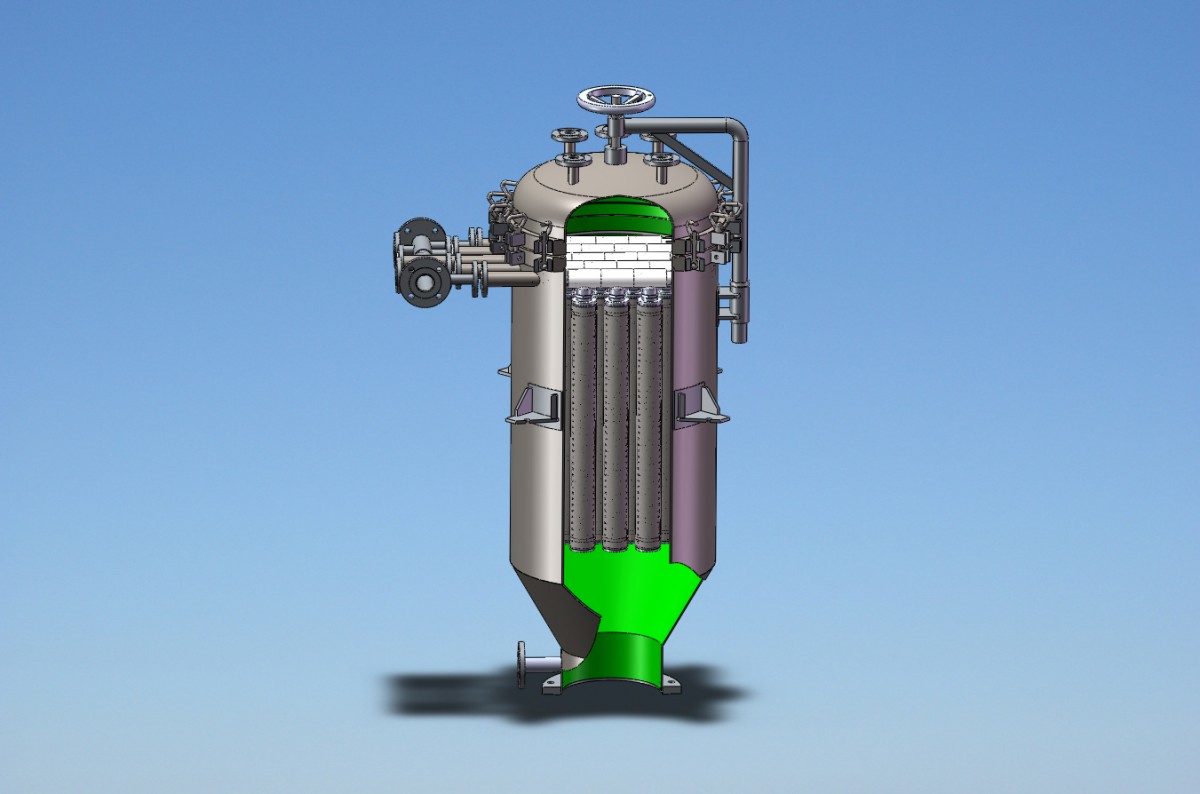
1. How Does an Industrial Candle Filter Work?
A candle filter consists of several cylindrical filter elements, commonly called candles, arranged vertically inside a pressure vessel. Each element provides a filtration surface supported by a rigid internal structure.
Depending on the equipment design, filter media may include woven filter cloth, sintered metal, or other specialized filtration materials.
1.1 Main Components
A typical industrial candle filtration system includes the following components:
| Component | Function |
|---|---|
| Pressure vessel | Contains the filtration process under controlled pressure |
| Candle filter elements | Provide the filtration surface |
| Filter media | Retains suspended particles |
| Filtrate collection system | Collects and transports filtered liquid |
| Inlet and outlet connections | Control process fluid movement |
| Backblowing system | Detaches accumulated filter cake |
| Bottom discharge valve | Removes collected solids |
| PLC control system | Coordinates filtration and cleaning cycles |
The filter elements are arranged to maximize filtration area within a relatively compact vessel.
The supporting structure prevents the filter media from collapsing under differential pressure while allowing the liquid to pass through.
1.2 The Filtration Process
The operating cycle generally involves five stages.
Stage 1: Liquid Feeding
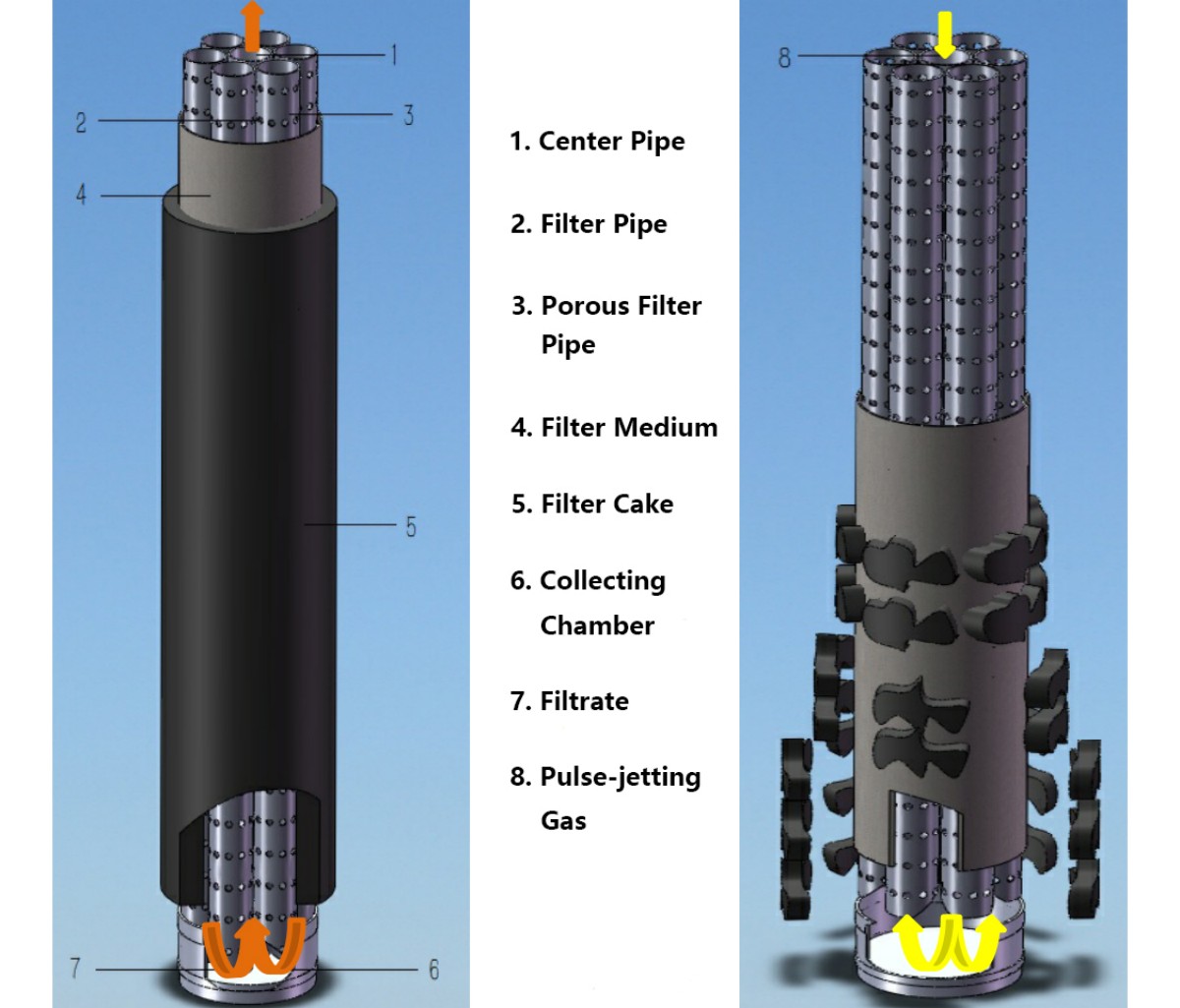
The suspension enters the pressure vessel through the feed connection. The liquid is distributed around the external surfaces of the candle elements.
Stage 2: Solid Retention
As the suspension passes through the filter media, suspended particles are retained on the element surfaces.
The clarified liquid enters the internal channels of the filter elements and flows toward the filtrate outlet.
Stage 3: Filter Cake Formation
As filtration continues, retained solids accumulate and form a porous cake.
This cake becomes an additional filtration layer. Depending on particle characteristics, cake formation can improve particle retention beyond the initial capability of the filter cloth.
However, the cake also increases hydraulic resistance. Consequently, differential pressure gradually rises as the cake becomes thicker.
Stage 4: Cake Washing or Drying
Where the process requires higher product purity or reduced liquid content, additional washing or gas-assisted drying operations may be incorporated.
Cake washing helps remove soluble impurities retained within the solid layer.
Gas displacement can reduce the amount of liquid remaining in the cake, although the achievable residual moisture depends on cake permeability, compressibility, and operating conditions.
Stage 5: Automatic Cake Discharge
When the filtration cycle reaches its predefined endpoint, the feed is stopped and the system enters its cleaning sequence.
A controlled pulse of compressed gas or another suitable backblowing medium is introduced through the filter elements. This reverses the flow direction and detaches the accumulated cake.
The released solids fall toward the bottom discharge outlet.
The system can then prepare for another filtration cycle.
2. What Types of Industrial Applications Use Candle Filters?
Candle filters are generally selected when conventional filtration equipment cannot adequately address the combined requirements of fine separation, solid recovery, process containment, or automated cake handling.
2.1 Petrochemical and Catalyst Recovery
Catalysts are valuable materials used in many petrochemical and chemical production processes.
After participating in a reaction, catalyst particles may remain suspended in process liquids. Recovering these particles is important for reducing material losses and controlling downstream contamination.
A candle filter can separate suspended catalyst particles through surface filtration and cake formation.
Its enclosed pressure-vessel configuration also helps limit operator exposure to hazardous process liquids.
For catalyst recovery, equipment selection should consider:
- Catalyst particle-size distribution.
- Solid concentration in the feed.
- Liquid viscosity and operating temperature.
- Chemical compatibility of the filter media.
- Required residual moisture in recovered solids.
- Cake discharge characteristics.
A particularly important consideration is cake permeability. Fine catalyst particles can create a dense cake with relatively high resistance, potentially reducing filtration throughput.
2.2 Fine Chemical Processing
Fine chemical production frequently involves solvents, intermediate products, pigments, and suspended reaction residues.
A closed candle filtration system can help separate these solids while reducing the need for open handling.
For solvent-based applications, engineers should evaluate:
- Solvent compatibility with filter media and seals.
- Operating pressure and temperature.
- Volatility and flammability.
- Required equipment grounding and hazardous-area classification.
- Cleaning and product-changeover requirements.
The pressure vessel, valves, instrumentation, and associated piping must be designed for the actual process hazards.
2.3 Lithium Battery Material Processing
Lithium battery manufacturing involves several liquid-solid separation processes, including the removal of suspended particles from chemical solutions and the recovery of valuable process materials.
Candle filters may be considered when the process requires controlled solid retention and automated filter cake handling.
However, not every lithium-related filtration duty is suitable for candle filtration.
The appropriate solution depends on the chemical composition, particle morphology, viscosity, filtration target, and whether the retained solids must be recovered.
2.4 Fermentation and Biomass Separation
Fermentation broth can contain microorganisms, cell fragments, proteins, and other suspended biological materials.
Where the objective is to recover biomass or separate suspended solids, candle filtration may be evaluated as one possible solid-liquid separation technology.
Important factors include:
- Biomass concentration.
- Particle and floc size.
- Broth viscosity.
- Filter cake compressibility.
- Required product recovery.
- Cleaning and contamination-control requirements.
Biological suspensions can form highly compressible cakes. Pilot filtration testing is therefore important before selecting the final equipment.
3. What Are the Main Technical Parameters of a Candle Filter?
The operating performance of a candle filter depends on several interacting variables rather than filtration area or pressure alone.
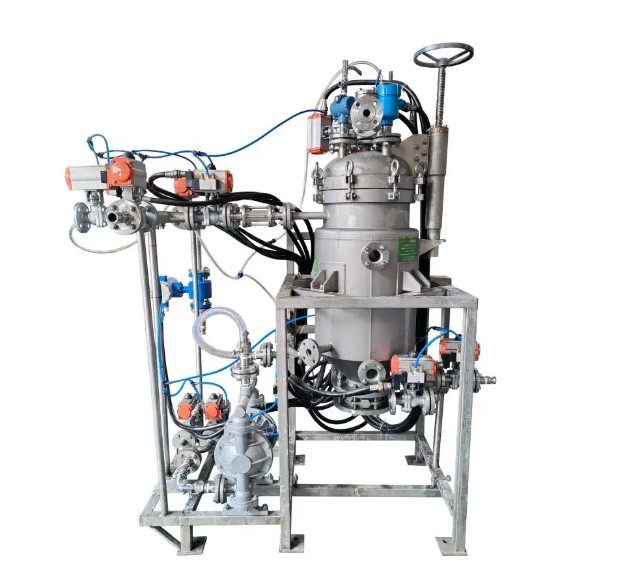
VITHY’s VZTF Automatic Self-cleaning Candle Filter provides a useful reference for understanding the available equipment configuration.
According to the published product specifications, its main technical ranges include:
| Parameter | Published VITHY VZTF Specification |
|---|---|
| Filtration area | 1–200 m² |
| Filtration rating | 1–1000 μm |
| Standard design pressure | 0.6 MPa / 1.0 MPa |
| Higher pressure | Customizable |
| Filter housing diameter | Φ300–3000 mm |
| Filter cloth materials | PP, PET, PPS, PVDF, PTFE |
| Filter cartridge materials | SS304, SS316L, FRPP, PVDF |
| Maximum operating temperature | Up to 260°C, depending on configuration |
| Stainless steel cartridge temperature | Published maximum of 600°C |
| Control system | Siemens PLC |
These figures are published product ranges, not guaranteed operating conditions for every application.
The actual filtration capacity depends on liquid viscosity, suspended solid concentration, particle characteristics, filtration rating, and operating temperature.
Material compatibility and temperature limits must also be checked for the complete assembly, including filter media, seals, valves, and housing.
3.1 Filtration Area
Filtration area determines the available surface for liquid-solid separation.
A larger filtration area can reduce the average filtration flux required for a given flow rate.
The basic relationship is:
Filtration Flux = Liquid Flow Rate / Effective Filtration Area
For example, a process requiring 20 m³/h with 20 m² of effective filtration area has an average filtration flux of:
20 / 20 = 1 m³/(m²·h)
This is only a preliminary sizing calculation. Final design must account for cake resistance, viscosity, pressure limitations, and the required filtration cycle duration.
3.2 Filtration Rating
Filtration rating describes the particle retention capability associated with the selected filter media and operating conditions.
A nominal micron rating should not automatically be interpreted as an absolute particle-removal guarantee.
Actual separation performance depends on media construction, particle shape, particle-size distribution, cake formation, and operating stability.
For demanding applications, representative feed testing is recommended.
3.3 Operating Pressure
Pressure provides the driving force for liquid flow through the filter media and accumulated cake.
Increasing pressure does not always produce a proportional increase in filtration capacity.
For compressible particles, higher pressure may compact the cake, increasing its resistance and reducing permeability.
Consequently, pressure selection should be based on filtration testing and mechanical design requirements rather than simply choosing the highest available pressure rating.
4. When Should Engineers Choose a Candle Filter?
A candle filter is worth evaluating when the process has several of the following characteristics:
- The feed contains suspended solids requiring fine separation.
- Valuable solids must be recovered rather than discarded.
- The process benefits from cake washing or gas-assisted drying.
- The liquid requires enclosed processing.
- High solid loading makes disposable cartridge filtration expensive.
- Automated filtration and cake discharge are desirable.
- The process requires a relatively large filtration area within a pressure vessel.
However, candle filters are not universally suitable.
For low-solid-content polishing applications, cartridge filters may provide a simpler solution.
For coarse particle removal, basket filters may be more economical.
For applications involving specific continuous cleaning requirements, self-cleaning scraper or back-flushing filters may be more appropriate.
The correct equipment depends on the separation objective and process characteristics.
5. How to Evaluate a Candle Filter Before Purchasing?
Industrial buyers should prepare a complete process specification before requesting a quotation.
The following information is particularly important:
| Required Information | Why It Matters |
|---|---|
| Liquid composition | Determines material compatibility |
| Operating temperature | Influences media and seal selection |
| Operating pressure | Determines vessel and system design |
| Flow rate | Establishes preliminary equipment capacity |
| Solid concentration | Affects cake formation and discharge frequency |
| Particle-size distribution | Influences filtration media selection |
| Liquid viscosity | Affects hydraulic resistance |
| Required filtration rating | Determines separation requirements |
| Cake moisture target | Influences washing and drying design |
| Solid recovery requirements | Determines discharge configuration |
A supplier should evaluate these parameters together rather than selecting a model based solely on nominal flow rate.
For complex applications, laboratory or pilot filtration tests can provide useful information about cake resistance, filtration time, washing effectiveness, and discharge behavior.
Frequently Asked Questions
Q1: Is a candle filter suitable for high-solid-content liquids?
Yes. Candle filters can be designed for high-solid-content applications because the filter cake provides additional solids-holding capacity. However, the allowable solids loading depends on cake permeability, vessel volume, and discharge frequency.
Q2: Can a candle filter operate automatically?
Yes. Automatic models can integrate PLC control, pressure monitoring, feeding, backblowing, and cake discharge. The actual automation scope depends on the selected configuration.
Q3: Does a candle filter produce dry filter cake?
It can produce relatively dry filter cake through gas-assisted drying and controlled discharge. However, the final moisture content depends on cake properties, process conditions, and equipment configuration.
Q4: What industries commonly use candle filters?
Typical applications include petrochemicals, fine chemicals, catalyst recovery, lithium battery materials, and selected fermentation processes.
Q5: How do I select the correct candle filter model?
Provide the liquid composition, flow rate, temperature, pressure, solid concentration, particle-size distribution, and required filtration rating. These parameters allow engineers to evaluate the appropriate filtration area, media, and vessel configuration.
A candle filter is more than a conventional liquid filtration device. It is a pressure-based solid-liquid separation system capable of combining filtration, cake formation, washing, drying, and automatic solids discharge.
Its main value lies in applications where fine particle separation, controlled solid recovery, process containment, and automated operation are important.
For industrial buyers, the most reliable selection approach is to evaluate the complete process rather than focusing on a single specification.
Need help selecting an industrial candle filter?
Contact VITHY’s engineering team with your process parameters to evaluate the appropriate filter media, filtration area, operating pressure, and discharge configuration.
Post time: Nov-19-2026


