

Candle filter filtration efficiency depends on the filter media, particle-size distribution, cake structure, liquid viscosity, solids concentration, and operating pressure. These factors interact throughout the filtration cycle, affecting filtrate quality, flow rate, pressure drop, and cake discharge. Optimizing a candle filter therefore requires evaluating the complete process rather than changing one parameter independently.
1. Understanding Candle Filter Filtration Efficiency
Filtration efficiency is not determined by a single equipment specification. In industrial solid-liquid separation, it generally refers to how effectively a filtration system retains suspended solids while maintaining an acceptable filtrate flow rate and operating cycle.
For a candle filter, several performance indicators should be considered together:
- Particle retention: The proportion of suspended particles retained by the filter medium and developing filter cake.
- Filtrate quality: The residual solids concentration, particle count, or turbidity of the filtered liquid.
- Filtration rate: The volume of filtrate processed per unit of time.
- Pressure drop: The resistance encountered as liquid passes through the filter medium and cake.
- Cake characteristics: Cake thickness, permeability, moisture content, and discharge behavior.
- Cycle performance: The time required for filtration, liquid recovery, cleaning, and preparation for the next cycle.
These indicators are interconnected.
For example, a filter cloth with a finer structure may improve initial particle retention, but it may also increase flow resistance. Increasing filtration pressure may initially improve liquid flow, but a compressible filter cake can become denser and more resistant.
The objective is therefore not simply to maximize filtration precision or pressure. It is to achieve the required filtrate quality at a practical processing rate and operating cost.
2. How Does a Candle Filter’s Filtration Efficiency Work?
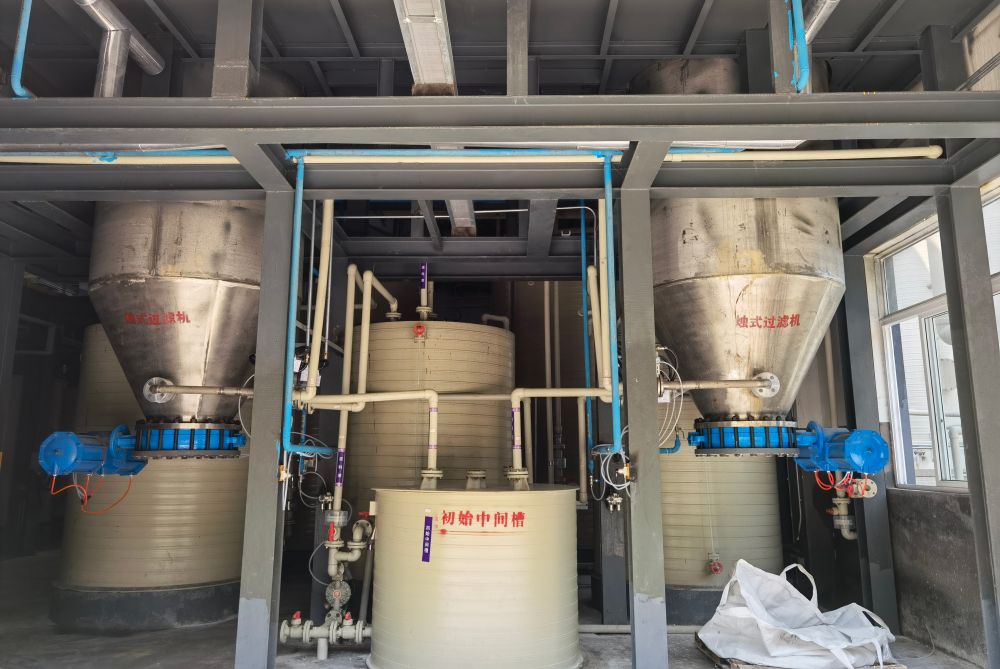
A candle filter typically consists of multiple tubular filter elements installed inside a sealed pressure vessel. Each element is covered with a suitable filter cloth or filtration medium.
During operation, slurry enters the vessel and flows through the filtration layer. Suspended solids accumulate on the outer surface of the filter elements, while the liquid passes through the media and enters the internal filtrate channels.
As filtration continues, the accumulated solids form a filter cake.
The filtration process involves two main resistances:
- Resistance from the filter medium.
- Resistance from the accumulated filter cake.
A simplified relationship based on Darcy’s law is:
Q = A × ΔP / [μ × (Rm + Rc)]
Where:
- Q = volumetric filtrate flow rate.
- A = effective filtration area.
- ΔP = pressure difference across the filtration system.
- μ = dynamic viscosity of the liquid.
- Rm = resistance of the filter medium.
- Rc = resistance of the filter cake.
This equation illustrates several important relationships:
- Increasing the available pressure difference can increase flow under otherwise comparable conditions.
- Higher liquid viscosity generally reduces flow at the same pressure and resistance.
- A thicker or denser filter cake increases filtration resistance.
- A larger effective filtration area can increase total flow capacity when other conditions remain comparable.
In actual industrial operation, cake resistance may change continuously as particles accumulate and the cake becomes compressed. Consequently, the equation provides an engineering framework rather than a complete prediction of every operating cycle.
3. Seven Key Factors That Affect Candle Filter Filtration Efficiency
3.1 Filter Cloth Pore Structure and Material
The filter cloth is the first filtration barrier and has a direct influence on initial particle retention.
Its performance depends on more than the nominal micron rating. Important characteristics include:
- Pore-size distribution.
- Weave structure.
- Surface properties.
- Permeability.
- Mechanical strength.
- Chemical and temperature resistance.
A finer filter medium may retain smaller particles, but it can also increase initial resistance and become more susceptible to blockage.
A more permeable medium may support higher initial flow, but it must still meet the required particle-retention target.
The appropriate selection should balance filtrate quality, processing capacity, and operating stability.
Different materials may be suitable for different process conditions:
| Filter Cloth Material | General Characteristics | Selection Considerations |
|---|---|---|
| PP (Polypropylene) | Commonly used in industrial liquid filtration; offers broad chemical compatibility in many applications | Confirm compatibility with the specific chemicals, temperature, and cleaning agents |
| PET (Polyester) | Provides useful mechanical properties in many filtration applications | Evaluate hydrolysis resistance and operating temperature |
| PPS (Polyphenylene Sulfide) | Used in applications requiring elevated thermal and chemical resistance | Confirm compatibility with the specific process chemistry |
| PVDF | Offers chemical resistance for selected aggressive liquid applications | Evaluate temperature, mechanical properties, and chemical compatibility |
| PTFE | Provides broad chemical resistance and is used in demanding filtration environments | Consider permeability, mechanical support, and cleaning requirements |
Material selection should be based on the complete process chemistry rather than a general material ranking.
For example, a filter cloth suitable for an aqueous mineral slurry may not be suitable for a hot solvent-based chemical process.
3.2 Particle-Size Distribution and Particle Morphology
Particle characteristics determine how solids accumulate on the filter medium and develop into a cake.
A slurry containing mostly coarse particles may form a relatively permeable cake. However, when a significant proportion of fine particles is present, these fines can occupy the spaces between larger particles and reduce cake permeability.
Particle morphology also matters.
| Particle Characteristic | Possible Effect on Filtration |
|---|---|
| Coarse, rigid particles | May form a relatively permeable cake, depending on particle shape and size distribution |
| Fine particles | May increase cake resistance and affect filtrate clarity |
| Irregular particles | Can produce less uniform cake structures |
| Fibrous particles | May bridge across media openings or create highly porous, irregular cakes |
| Soft or deformable particles | May change shape under pressure and reduce cake permeability |
| Agglomerated particles | May behave differently from their primary particle-size distribution |
For this reason, engineers should not rely exclusively on an average particle diameter.
Useful characterization parameters include:
- D10: Particle diameter below which 10% of the measured particle volume or number falls, depending on the measurement basis.
- D50: Median particle diameter.
- D90: Particle diameter below which 90% of the measured particle volume or number falls.
- Particle shape and agglomeration behavior.
- Solids concentration and its variation over time.
The measurement basis should be stated because volume-based and number-based particle-size distributions are not directly interchangeable.
3.3 Filter Cake Structure and Compressibility
Cake formation is central to candle filtration.
As solids accumulate on the filter cloth, the cake becomes an additional filtration layer. It can improve particle retention, but it also creates resistance to liquid flow.
Cake permeability depends on several properties:
- Particle size and distribution.
- Particle shape.
- Porosity.
- Solids packing.
- Cake thickness.
- Applied pressure.
One important distinction is whether the cake is compressible.
An incompressible cake maintains relatively stable structural characteristics as pressure changes. A compressible cake, however, may become denser when subjected to greater pressure.
This reduces its porosity and permeability, potentially increasing filtration resistance.
For such materials, increasing pressure may not deliver the expected improvement in processing capacity.
The cake may instead become more compact, causing pressure to rise while filtrate flow increases only slightly or even declines under certain operating conditions.
This is why filter-cake behavior should be evaluated through representative testing before equipment sizing.
3.4 Liquid Viscosity and Operating Temperature
Liquid viscosity directly influences the resistance to flow through the filter medium and filter cake.
According to the simplified filtration relationship, flow rate is inversely proportional to dynamic viscosity when other variables remain constant.
This means that a more viscous liquid generally requires a greater pressure difference or a larger filtration area to achieve a comparable flow rate.
Temperature can influence viscosity, but the relationship depends on the liquid.
For many industrial liquids, viscosity decreases as temperature increases. However, temperature also affects chemical stability, material compatibility, vapor pressure, and equipment design requirements.
For example:
- A viscous resin may become easier to filter after controlled heating.
- A solvent-based liquid may require temperature control to manage vapor pressure and safety considerations.
- A heat-sensitive product may not tolerate elevated temperatures even if filtration flow would improve.
Temperature should therefore be optimized according to both filtration performance and process safety.
The selected filter cloth, cartridge, seals, housing, and instrumentation must all be suitable for the intended operating conditions.
3.5 Solids Concentration in the Feed Slurry
Feed solids concentration affects how quickly the filter cake develops.
When the concentration of suspended solids increases, more material is delivered to the filter surface for a given volume of slurry.
This can accelerate cake formation and shorten the time required to reach a predetermined pressure or cake-loading limit.
However, higher solids concentration does not automatically mean lower filtration efficiency.
Its actual influence depends on:
- Particle-size distribution.
- Cake permeability.
- Slurry viscosity.
- Required filtrate volume.
- Available filtration area.
- Cake discharge capability.
For example, a relatively concentrated slurry containing coarse, rigid particles may form a manageable cake.
By contrast, a lower-solids slurry containing fine, compressible particles may still produce high filtration resistance.
Feed concentration should therefore be evaluated together with particle properties rather than treated as an independent sizing parameter.
3.6 Operating Pressure and Differential Pressure
Operating pressure provides the driving force for filtration.
However, it is important to distinguish between vessel design pressure, operating pressure, and differential pressure across the filtration medium and cake.
These values describe different engineering conditions.
- Design pressure: The pressure basis used for mechanical equipment design.
- Operating pressure: The pressure at which the system normally operates.
- Differential pressure: The pressure difference across the filtration system or a defined filtration component.
As filtration progresses, solids accumulate and resistance generally increases. This can cause the differential pressure to rise.
Increasing the operating pressure may temporarily support the required flow, but it does not eliminate the underlying cake resistance.
For compressible cakes, excessive pressure may compact the solids and reduce permeability.
A practical operating strategy should therefore establish:
- A suitable initial operating pressure.
- A normal filtration pressure range.
- A pressure or time condition for ending the filtration cycle.
- A safe cleaning and discharge sequence.
- A suitable operating margin below the equipment design limit.
The pressure settings should be determined through process testing and equipment engineering review.
3.7 Filtration Area and Cycle Time
The available filtration area affects the total capacity of the equipment.
A larger filtration area can provide more surface for liquid to pass through and solids to accumulate.
However, filtration area alone does not determine throughput.
The actual processing capacity also depends on:
- Slurry properties.
- Filter cloth permeability.
- Cake resistance.
- Required filtrate quality.
- Operating pressure.
- Cake thickness.
- Filtration cycle duration.
- Cleaning and discharge time.
For a batch or cyclic candle filtration process, the complete cycle should be considered.
A simplified cycle-time model is:
Total Cycle Time = Filtration Time + Liquid Recovery Time + Cleaning Time + Cake Discharge Time + Preparation Time
If cake formation takes a long time or cleaning and discharge are inefficient, increasing the installed filtration area may not deliver the expected improvement in overall production capacity.
The objective should be to optimize the complete operating cycle rather than maximize filtration area in isolation.
4. How to Balance Filtration Precision, Throughput, and Operating Cost

Industrial filtration projects often involve competing requirements.
A very fine filter medium may improve initial particle retention but increase pressure drop. A higher filtration pressure may support flow but compact a compressible cake. A larger filter area may increase equipment investment and installation requirements.
A practical selection process should evaluate these factors together.
| Optimization Objective | Parameters to Evaluate | Potential Trade-Off |
|---|---|---|
| Improve filtrate clarity | Filter cloth, particle retention, cake development | Higher resistance or longer filtration time |
| Increase throughput | Filtration area, pressure, viscosity, cake permeability | Higher equipment investment or energy consumption |
| Reduce operating cost | Cycle time, cleaning frequency, cake discharge, maintenance | May require additional testing or process adjustment |
| Improve cake discharge | Cloth surface, cake properties, discharge mechanism | May influence filtration or drying performance |
| Extend filter cloth service life | Chemical compatibility, pressure, cleaning conditions | A more suitable material may involve higher initial cost |
The best operating point is the one that meets the required product or downstream process quality while maintaining acceptable production capacity and lifecycle cost.
For example, if the filtrate is used as an intermediate process liquid, a moderate filtration rating followed by downstream polishing may be more economical than using an extremely fine filter medium in the primary candle filter.
The appropriate process configuration depends on the actual solids loading and final quality requirement.
5. How to Optimize Candle Filter Performance Through Process Testing
For difficult or high-value filtration applications, laboratory or pilot testing is often more reliable than selecting equipment solely from catalog specifications.
A structured testing process can help identify the main filtration limitations before equipment sizing.
Step 1: Collect Representative Feed Samples
The sample should reflect normal production conditions rather than an unusually clean or concentrated batch.
Record:
- Liquid composition.
- Solids concentration.
- Particle-size distribution.
- Particle morphology.
- Liquid viscosity.
- Operating temperature.
- Expected variation in feed conditions.
If the process has significant batch-to-batch variation, multiple representative samples may be necessary.
Step 2: Evaluate Filter Media Options
Select candidate filter cloth materials and structures based on the process chemistry and required filtrate quality.
Compare:
- Initial filtrate clarity.
- Initial flow rate.
- Pressure increase over time.
- Cake formation behavior.
- Cloth resistance.
- Cake-release characteristics.
A single clean-water permeability test cannot fully predict performance with an actual industrial slurry.
Step 3: Test Different Pressure Conditions
Evaluate how filtration rate and pressure drop change at different operating pressures.
The test should identify whether the cake behaves as a relatively incompressible or compressible structure.
If increased pressure causes rapid pressure buildup without a corresponding improvement in flow, cake compression or other resistance-related limitations should be investigated.
Step 4: Record Filtration and Cake Data
The following data can support equipment selection and process optimization.
| Test Parameter | What It Helps Determine |
|---|---|
| Initial filtrate flow rate | Initial media permeability and system response |
| Flow rate over time | Development of cake resistance |
| Differential pressure | Accumulation of filtration resistance |
| Filtration time | Practical cycle duration |
| Filtrate suspended solids | Liquid clarification performance |
| Particle count or particle-size analysis | Particle-retention performance |
| Cake thickness | Solids loading and available cake capacity |
| Cake moisture content | Liquid recovery and downstream solids handling |
| Cake discharge behavior | Cleaning and regeneration performance |
| Residual solids after cleaning | Effectiveness of the regeneration sequence |
Step 5: Evaluate the Complete Filtration Cycle
Testing should not stop when the filtrate first becomes clear.
The evaluation should include filtration, liquid recovery, cake discharge, and filter regeneration.
A filter that delivers acceptable filtrate quality but requires frequent manual cleaning may not be the most suitable choice for an automated production line.
Similarly, a system with high initial flow may become inefficient if its pressure rises rapidly during cake formation.
The final selection should be based on representative operating cycles.
6. How VITHY VZTF Candle Filter Configuration Relates to Filtration Performance
VITHY’s VZTF Automatic Self-cleaning Candle Filter is designed for industrial solid-liquid separation applications involving high solid content, viscous liquids, high-temperature conditions, and other complex filtration requirements.
Its configuration can be selected according to the characteristics of the process.
According to VITHY’s published product specifications:
| Parameter | Published Specification |
|---|---|
| Filtration area | 1–200 m² |
| Filtration rating | 1–1,000 μm, depending on filter element selection |
| Standard design pressure | 0.6 MPa / 1.0 MPa |
| Higher pressure | Customizable |
| Filter cloth materials | PP, PET, PPS, PVDF, PTFE, etc. |
| Filter cartridge materials | SS304, SS316L, FRPP, PVDF |
| Housing materials | SS304, SS316L, SS2205, carbon steel, and other options |
| Maximum operating temperature | Up to 260°C, depending on configuration |
| Control system | Siemens PLC, according to published specifications |
These figures describe published equipment configuration ranges. They do not guarantee a particular filtration rate, particle-removal efficiency, or cycle time under every process condition.
The manufacturer also notes that flow rate is affected by liquid viscosity, temperature, filtration rating, and particle content.
For a specific project, the filtration area, filter cloth, cartridge material, housing material, pressure rating, and automation configuration should be confirmed against the actual process conditions.
6.1 Automatic Cleaning and Its Role in Stable Operation
The VZTF system uses a programmed cleaning sequence.
According to the product description, when the preset pressure or time condition is reached, the PLC sends a signal to stop feeding and initiate the configured cleaning and discharge process.
Depending on the system configuration, this can involve back-blowing or back-flushing to detach accumulated solids from the filter elements.
The cleaning sequence is important because residual solids may influence the resistance of the next filtration cycle.
However, automatic cleaning does not mean that every type of cake can be completely removed under identical conditions.
Cake adhesion, particle properties, filter cloth selection, and cleaning parameters all affect regeneration performance.
For applications with difficult-to-release solids, testing should confirm the cleaning sequence before final equipment selection.
7. Frequently Asked Questions
Q1: Does higher pressure always improve candle filter efficiency?
No. Higher pressure can increase the driving force for filtration, but it may also compress a compressible filter cake and reduce permeability. The effect depends on the slurry and cake properties. Pressure optimization should be based on representative filtration tests.
Q2: Why does candle filter flow rate decrease during operation?
A common reason is the accumulation of suspended solids on the filter cloth, which increases cake resistance. Other possible causes include high liquid viscosity, fine-particle loading, filter cloth blockage, and unsuitable operating conditions. Differential pressure and filtrate flow trends should be evaluated together.
Q3: Can changing the filter cloth improve filtration performance?
Yes, when the existing cloth is unsuitable for the process. A different material or pore structure may improve particle retention, permeability, chemical compatibility, or cake release. However, a finer cloth does not automatically provide better overall performance.
Q4: Does higher solids concentration always reduce filtration capacity?
Not necessarily. Higher solids concentration can accelerate cake formation, but the effect on total processing capacity depends on cake permeability, particle properties, and cycle time. A concentrated slurry with coarse particles may behave differently from a dilute slurry containing fine, compressible solids.
Q5: How can engineers determine the correct filtration pressure?
Engineers should evaluate the relationship between pressure, filtrate flow, cake formation, and pressure drop through laboratory or pilot testing. The selected pressure must also remain within the mechanical design limits of the equipment.
Conclusion
Candle filter filtration efficiency is determined by the combined effects of filter media, particle properties, cake structure, liquid viscosity, solids concentration, operating pressure, filtration area, and cycle time.
Improving one parameter in isolation does not necessarily improve overall performance. A finer filter cloth may increase resistance, higher pressure may compact a compressible cake, and a larger filtration area may not solve inefficient cake discharge.
For industrial applications, the most reliable approach is to characterize the feed slurry, evaluate suitable filter media, conduct representative filtration tests, and assess the complete operating cycle.
VITHY’s VZTF Automatic Self-cleaning Candle Filter offers configurable filtration areas, filter materials, and operating pressure options for different industrial applications. The appropriate configuration should be confirmed through engineering evaluation and process-specific testing.
Need to optimize candle filter performance for your process? Contact VITHY’s engineering team with your slurry composition, solids concentration, particle-size distribution, liquid viscosity, operating temperature, and required filtrate quality to discuss a suitable filtration configuration.
Post time: Nov-23-2026


