

Biomass separation from fermentation broth is a solid-liquid separation process used to remove microorganisms, cells, cell debris, and other suspended biological materials from fermentation liquids. Depending on the process objective, separation can be performed using centrifuges, membrane filtration, pressure filters, or other industrial filtration systems. Candle filters can be considered when biomass recovery, enclosed processing, and filter cake handling are required.
Fermentation broth is more complex than conventional industrial slurry. It may contain microorganisms, proteins, residual nutrients, colloidal substances, extracellular products, and suspended impurities. These components can create significant filtration resistance and affect downstream product recovery.
For biotechnology, pharmaceutical, food, and biochemical manufacturers, the main objective is not simply to remove suspended solids. Engineers must also consider product yield, biomass characteristics, filtrate quality, process hygiene, and operating costs.
1. Why Is Biomass Separation Important in Fermentation Processes?
Fermentation is widely used to produce antibiotics, enzymes, organic acids, amino acids, yeast products, and other biological materials.
After fermentation, the resulting broth usually contains both liquid products and suspended biological solids.
The separation objective depends on whether the target product is extracellular or intracellular.
1.1 Extracellular Product Recovery
In extracellular fermentation, the target product is released into the liquid phase.
Examples include certain organic acids, enzymes, and antibiotics.
The main objective is to remove microorganisms and suspended solids while retaining the dissolved product in the filtrate.
A suitable separation system should therefore provide:
- Effective biomass retention.
- High liquid product recovery.
- Acceptable filtrate clarity.
- Low product adsorption or degradation.
- Stable filtration performance.
For these applications, the biomass is generally treated as a separated solid residue rather than the primary product.
1.2 Intracellular Product Recovery
In intracellular fermentation, the target product remains inside microbial cells.
The process therefore requires biomass harvesting before cell disruption or extraction.
Typical downstream operations may include:
- Biomass concentration.
- Cell harvesting.
- Cell disruption.
- Product extraction.
- Solid-liquid separation.
- Product purification.
In this situation, biomass recovery efficiency becomes a critical process indicator.
The filtration system must retain the target cells while minimizing losses during liquid discharge and solids handling.
The appropriate equipment depends on cell size, biomass concentration, broth viscosity, and the physical properties of the target product.
2. What Makes Fermentation Broth Difficult to Filter?
Fermentation broth often exhibits filtration characteristics that differ substantially from those of conventional mineral or chemical suspensions.
Three factors are particularly important.
2.1 Small Particle Size and Biological Cell Structure
Microorganisms and cell fragments can have relatively small particle sizes.
Depending on the fermentation process, the suspension may contain bacteria, yeast, fungal mycelia, cell debris, and colloidal materials.
These particles may accumulate within filter media openings or form dense deposits on the filtration surface.
Consequently, the selected filter medium must balance particle retention with adequate liquid permeability.
2.2 High Cake Compressibility
Biological solids are often deformable.
Under increasing filtration pressure, microbial cells and biological aggregates may become compressed.
This reduces cake porosity and restricts the flow channels through which the liquid passes.
The result can be a substantial increase in filtration resistance.
This explains why increasing operating pressure does not always improve filtration throughput.
Engineers should evaluate cake resistance under different pressure conditions before determining the final operating parameters.
2.3 High and Variable Broth Viscosity
Fermentation broth may contain extracellular polymers, proteins, polysaccharides, and other dissolved substances.
These components can increase apparent viscosity and create non-Newtonian flow behavior.
Higher viscosity generally increases hydraulic resistance and reduces filtration flux under otherwise comparable conditions.
Broth viscosity may also change throughout the fermentation cycle.
Therefore, equipment selection should be based on representative feed samples rather than a single nominal viscosity value.

3. What Filtration Technologies Can Separate Biomass from Fermentation Broth?
There is no universally suitable separation technology for every fermentation process.
The appropriate solution depends on whether the objective is biomass harvesting, broth clarification, product recovery, or removal of fine cell debris.
| Separation Technology | Main Mechanism | Typical Application | Main Consideration |
|---|---|---|---|
| Centrifuge | Centrifugal force | Biomass harvesting and concentration | Energy consumption and particle settling characteristics |
| Membrane filtration | Pressure-driven membrane separation | Fine clarification and cell retention | Membrane fouling and cleaning |
| Pressure leaf filter | Pressure-driven cake filtration | Biomass and filter-aid-assisted separation | Cake discharge and cleaning |
| Candle filter | Pressure filtration with cake formation | Enclosed solid-liquid separation and cake recovery | Cake permeability and discharge characteristics |
| Filter press | Pressure-driven filtration between plates | High-solids biomass separation | Batch handling and mechanical operation |
For applications requiring fine clarification, membrane filtration may be appropriate.
For processes requiring high biomass concentration, centrifugation is frequently considered.
For applications involving recoverable solids, filter cake washing, or enclosed pressure filtration, candle filters may also be evaluated.
The final selection should be supported by filtration or separation testing.
4. How Does a Candle Filter Separate Biomass from Fermentation Broth?
A candle filter separates suspended biomass through pressure-driven filtration and progressive filter cake formation.
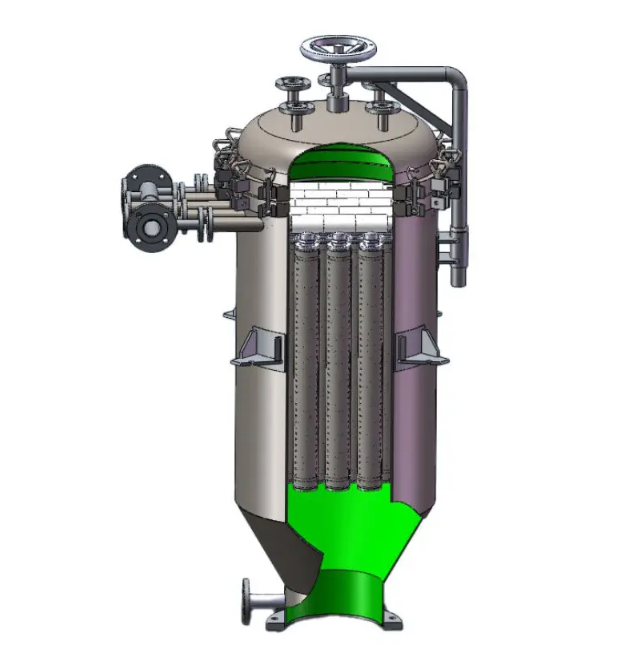
The system contains multiple cylindrical filter elements installed inside a closed pressure vessel.
Each element is covered with selected filter media supported by an internal structure.
The filtration process generally includes five stages.
4.1 Stage One: Fermentation Broth Feeding
The fermentation broth is transferred from the fermentation tank or an intermediate holding vessel into the candle filter.
Before feeding, engineers should confirm that the broth is compatible with the equipment materials and operating conditions.
Important feed parameters include:
- Biomass concentration.
- Microorganism type.
- Particle-size distribution.
- Broth viscosity.
- Operating temperature.
- pH value.
- Presence of extracellular polymers.
- Required processing capacity.
Where large aggregates or foreign particles are present, upstream screening or pretreatment may be necessary.
4.2 Stage Two: Biomass Retention
The broth enters the pressure vessel and flows around the external surfaces of the candle elements.
Liquid passes through the filter media and enters the internal filtrate channels.
Biological solids are retained on the external filter surface.
The selected media must provide sufficient particle retention without creating excessive resistance.
For some applications, filter aids such as diatomaceous earth, perlite, or cellulose may be considered.
Pre-coating can help establish a more permeable initial filtration layer and reduce direct blockage of the filter cloth.
However, filter aids should only be introduced after evaluating their compatibility with the target product and downstream process.
4.3 Stage Three: Filter Cake Formation
As filtration continues, biomass accumulates on the candle elements.
The deposited material forms a filter cake that provides an additional particle-retention layer.
The cake structure depends on cell morphology, particle aggregation, biomass concentration, and operating pressure.
A highly compressible biomass cake can develop substantial hydraulic resistance.
Consequently, filtration cycle duration should be controlled according to differential pressure, filtrate flow rate, or another validated process endpoint.
4.4 Stage Four: Filtrate Collection
The clarified liquid passes through the internal channels of the candle elements and exits through the filtrate outlet.
If the target product is extracellular, this filtrate may contain the desired biological product.
However, the actual product recovery depends on its concentration, solubility, adsorption characteristics, and chemical stability.
For sensitive pharmaceutical applications, additional downstream clarification or purification may be required.
Candle filtration should not automatically be considered equivalent to sterilizing-grade filtration.
Microbial control and aseptic processing requirements must be evaluated separately.
4.5 Stage Five: Biomass Cake Discharge
When the filtration cycle reaches its predefined endpoint, feed is stopped.
Depending on the process configuration, residual liquid can be drained or recovered.
A controlled reverse-flow pulse can then detach the accumulated cake from the filter elements.
Compressed air or nitrogen may be considered as the backblowing medium, subject to process compatibility and equipment design.
The released biomass falls toward the bottom discharge section and is removed through the discharge valve.
For applications requiring biomass recovery, the discharge method should minimize unnecessary material loss and avoid damaging the recovered solids.
5. How Should Engineers Optimize Biomass Filtration Performance?
The performance of a biomass filtration system depends on the interaction between feed properties, filter media, pressure, and cake structure.
Several operating parameters require careful evaluation.
5.1 Filter Media Selection
Filter media selection should be based on microorganism size, required retention, chemical compatibility, and cleaning requirements.
Potential materials include:
- Polypropylene (PP).
- Polyester (PET).
- Polyphenylene sulfide (PPS).
- Polyvinylidene fluoride (PVDF).
- Polytetrafluoroethylene (PTFE).
The appropriate material depends on the broth composition, temperature, pH, cleaning chemicals, and mechanical requirements.
A nominal micron rating alone cannot guarantee complete microorganism retention.
Particle retention should be verified through representative testing.
5.2 Operating Pressure
Operating pressure determines the driving force for liquid movement through the filter media and biomass cake.
However, excessive pressure can compact biological solids and reduce cake permeability.
For compressible biomass, engineers should conduct pressure-step filtration tests.
The objective is to identify an operating range that balances filtration throughput and cake resistance.
5.3 Filtration Area
The preliminary filtration area can be estimated using:
A = Q / J
Where:
- A = Effective filtration area (m²).
- Q = Required filtrate flow rate (m³/h).
- J = Design filtration flux (m³/m²·h).
For example, if the required filtrate capacity is 5 m³/h and pilot testing indicates a sustainable filtration flux of 0.25 m³/(m²·h), the preliminary filtration area is:
5 / 0.25 = 20 m².
This calculation is only a preliminary sizing reference.
Final equipment selection should consider cake resistance, operating cycle duration, solids loading, and cleaning frequency.
5.4 Cake Washing and Residual Liquid Control
Where biomass contains valuable soluble components, cake washing may help recover residual product or remove unwanted substances.
The washing medium must be compatible with the biomass and the target product.
For intracellular products, the process may require additional cell disruption or extraction after biomass recovery.
Cake moisture and retained liquid should also be considered when evaluating biomass handling and downstream processing costs.
6. What Are the Main Advantages of Using Candle Filters in Fermentation Applications?
When the feed characteristics are suitable, candle filters can offer several process advantages.
| Equipment Characteristic | Potential Process Benefit |
|---|---|
| Enclosed pressure vessel | Reduces direct exposure to process liquids |
| Multiple cylindrical elements | Provides substantial filtration area |
| Cake filtration mechanism | Supports biomass and suspended-solids retention |
| Cake washing capability | Allows additional treatment of retained solids |
| Automatic backblowing | Supports controlled cake removal |
| PLC control | Coordinates filtration and cleaning cycles |
VITHY identifies fermentation broth filtration among the applications of its industrial filtration equipment.
Its VZTF Automatic Self-cleaning Candle Filter supports filtration functions including pre-coating, cake formation, cake washing, and automatic discharge.
These functions may be relevant to selected fermentation processes where the biomass forms a filterable cake.
However, the equipment should not be assumed suitable for every biological suspension.
Highly compressible biomass, stringent aseptic requirements, and very low permissible microbial breakthrough may require alternative or additional separation technologies.
7. VITHY VZTF Candle Filter: Technical Configuration
VITHY’s published VZTF specifications provide the following equipment ranges:
| Technical Parameter | Published Specification |
|---|---|
| Filtration area | 1–200 m² |
| Filtration rating | 1–1000 μm |
| Standard design pressure | 0.6 MPa / 1.0 MPa |
| Higher pressure | Customizable |
| Filter cloth materials | PP, PET, PPS, PVDF, PTFE |
| Filter cartridge materials | SS304, SS316L, FRPP, PVDF |
| Housing materials | SS304, SS316L, SS2205, carbon steel and other options |
| Control system | Siemens PLC |
| Maximum operating temperature | Up to 260°C, depending on configuration |
These figures represent published product specifications, not guaranteed operating conditions for fermentation broth.
For biological applications, particular attention should be paid to:
- Wetted material compatibility.
- Cleaning chemical compatibility.
- Filter media retention performance.
- Drainability and residual liquid.
- Internal surface accessibility.
- Cleaning-in-place requirements.
- Product contamination risks.
Where pharmaceutical or food production requires hygienic or aseptic operation, the complete equipment design must be evaluated against the applicable process and regulatory requirements.
8. What Information Should Manufacturers Provide When Selecting a Biomass Filtration System?
A reliable equipment recommendation requires detailed process information.
| Required Parameter | Engineering Purpose |
|---|---|
| Fermentation type | Identifies the biological material |
| Biomass concentration | Estimates solids loading |
| Cell or particle size | Determines separation requirements |
| Broth viscosity | Evaluates hydraulic resistance |
| pH value | Supports material selection |
| Operating temperature | Determines equipment compatibility |
| Required filtrate clarity | Establishes separation objectives |
| Product location | Determines whether biomass or filtrate is the target |
| Processing capacity | Determines preliminary equipment size |
| Cake moisture requirement | Influences discharge and drying design |
| Cleaning requirements | Determines cleaning procedures and material selection |
Pilot testing is strongly recommended for difficult fermentation broths.
Testing should evaluate filtration flux, cake resistance, filtrate quality, biomass recovery, and cleaning performance.
For pharmaceutical applications, additional validation may be necessary to demonstrate that the filtration system consistently meets the required process specifications.
Frequently Asked Questions
Q1: What is the most effective method for separating biomass from fermentation broth?
There is no single best method for all fermentation processes. Centrifugation, membrane filtration, pressure filtration, and candle filtration should be evaluated according to biomass characteristics and the required product recovery.
Q2: Can a candle filter separate bacteria from fermentation broth?
A candle filter can retain suspended biological particles when the selected filter media and cake structure provide adequate retention. However, bacterial retention must be verified through testing. A candle filter should not automatically be considered a sterilizing-grade filtration system.
Q3: Why is fermentation broth difficult to filter?
Fermentation broth may contain small microorganisms, colloidal substances, extracellular polymers, and highly compressible biological solids. These components can increase cake resistance and cause filtration rates to decline.
Q4: Can candle filters recover valuable biomass?
Yes, selected candle filtration systems can collect biomass as filter cake. Recovery performance depends on particle retention, cake discharge efficiency, and the physical condition of the recovered material.
Q5: Can filter aids improve biomass filtration?
Yes. Materials such as diatomaceous earth and perlite can improve cake permeability in selected applications. However, their use must be evaluated against product purity, downstream processing, and material recovery requirements.
Biomass separation is an important downstream operation in fermentation, biotechnology, pharmaceutical, and food production.
The main engineering challenge is balancing biological particle retention, filtration throughput, product recovery, and process hygiene.
Centrifuges and membrane systems remain important technologies for many fermentation applications. Candle filters provide another option when enclosed pressure filtration, filter cake recovery, washing, and automatic solids discharge are required.
VITHY’s VZTF Automatic Self-cleaning Candle Filter can be evaluated for suitable fermentation broth applications, provided that biomass filterability, cake compressibility, material compatibility, and cleaning requirements are confirmed through testing.
Looking for an industrial filtration solution for fermentation broth?
Contact VITHY’s engineering team with your broth composition, biomass concentration, particle-size distribution, viscosity, processing capacity, and required filtrate quality.
The engineering team can evaluate the appropriate filtration technology, filter media, filtration area, and equipment configuration for your application.
Post time: Nov-19-2026


