

Catalyst recovery filtration in petrochemical plants is generally performed by separating suspended catalyst particles from process liquids through pressure-driven solid-liquid separation. An industrial candle filter can be used to retain catalyst particles on cylindrical filter elements, form a recoverable filter cake, and perform cake washing, gas-assisted drying, and automatic discharge within an enclosed vessel. The appropriate filtration process depends on catalyst properties, solvent compatibility, operating pressure, and recovery requirements.
Catalysts are essential materials in numerous petrochemical processes. They influence reaction rates, product selectivity, and production efficiency. However, catalyst particles can become suspended in process liquids during production, regeneration, or downstream separation.
Recovering these materials is important for reducing catalyst consumption, limiting downstream contamination, and improving resource utilization.
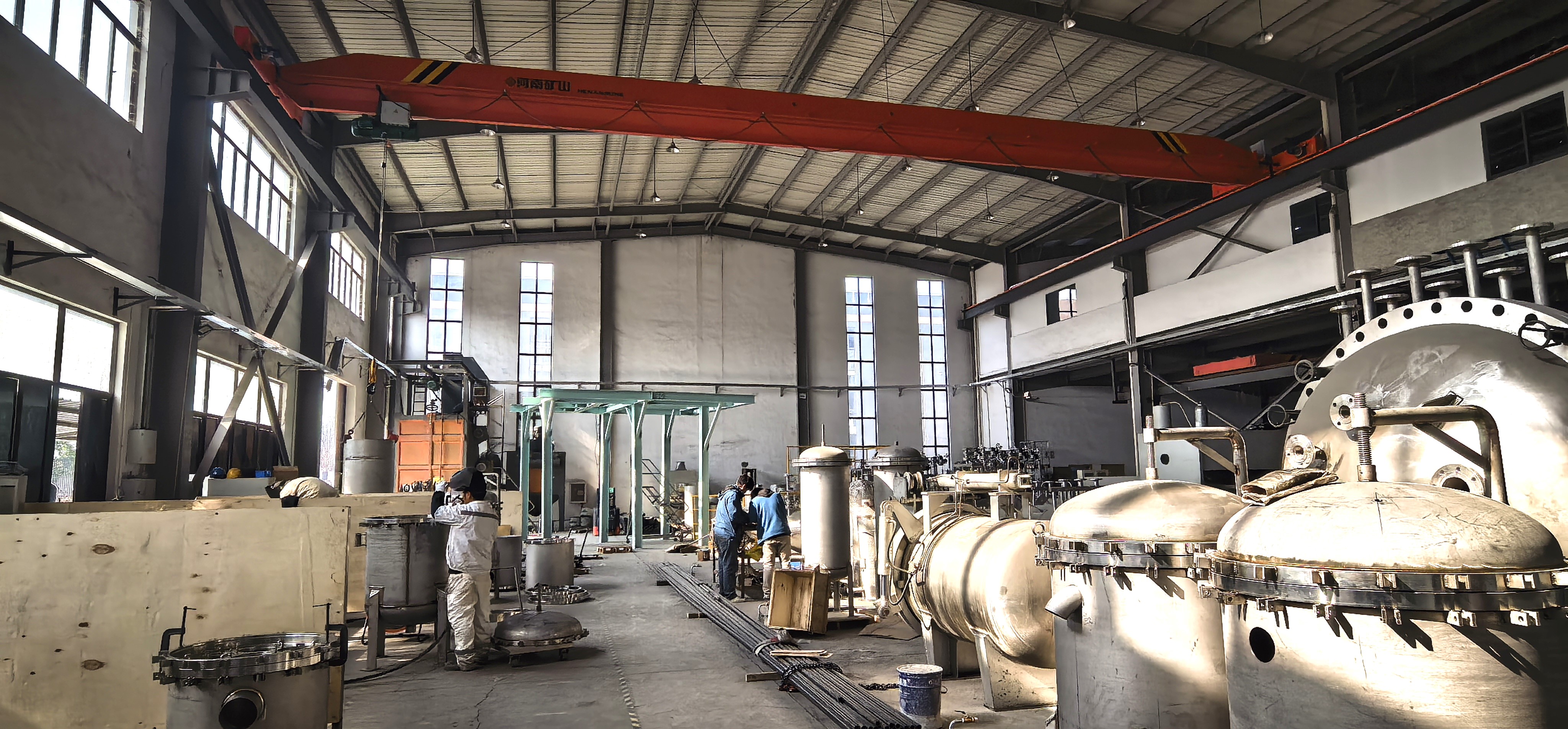
For processes involving valuable or hazardous catalysts, filtration equipment must address more than particle removal. It should also consider catalyst recovery efficiency, cake purity, residual liquid content, chemical compatibility, and process containment.
1. Why Is Catalyst Recovery Important in Petrochemical Processing?
Catalysts are used in different petrochemical operations, including hydroprocessing, catalytic reactions, polymer production, and chemical synthesis.
Depending on the process, catalysts may exist as powders, fine particles, supported particles, or suspended solids.
During operation, some catalyst particles can enter the liquid phase through mechanical attrition, particle fragmentation, catalyst handling, or process-specific separation requirements.
If these solids are not adequately removed, several problems may occur.
1.1 Catalyst Loss Increases Operating Costs
Many industrial catalysts contain valuable active components or require specialized manufacturing and activation processes.
Discarding catalyst-containing process residues without adequate recovery can increase material consumption and operating expenditure.
A suitable filtration system can retain suspended catalyst particles and allow the recovered solids to undergo further treatment, regeneration, or reuse where technically appropriate.
However, recoverability depends on catalyst activity, contamination, chemical stability, and the process owner’s reuse criteria.
1.2 Suspended Catalyst Particles Can Contaminate Downstream Products
Unremoved catalyst particles may enter downstream equipment or finished products.
Depending on the process, this can contribute to:
- Product contamination.
- Increased downstream filtration requirements.
- Fouling of heat exchangers.
- Wear in pumps and valves.
- Unstable product quality.
- Increased maintenance frequency.
Filtration at an appropriate process location helps control suspended solids before they affect subsequent operations.
1.3 Catalyst Disposal Creates Additional Environmental Costs
Catalyst-containing residues may require controlled handling and disposal.
Some spent catalysts contain hazardous substances or residual process chemicals.
Recovering valuable solids and reducing the volume of waste sent for disposal can improve resource utilization.
However, spent catalyst classification, handling, regeneration, and disposal must follow the applicable environmental and hazardous-material regulations.
2. How Does Catalyst Recovery Filtration Work?
The appropriate filtration process depends on the physical characteristics of the catalyst and the liquid in which it is suspended.
For applications involving fine catalyst particles and valuable recovered solids, pressure candle filtration can be an effective option.
A typical process involves five stages.
2.1 Stage One: Catalyst Slurry Feeding
The catalyst-containing liquid is transferred from the process vessel or intermediate storage tank into the candle filter.
Before selecting the feed pump and filtration equipment, engineers should determine:
- Catalyst concentration.
- Particle-size distribution.
- Liquid viscosity.
- Operating temperature.
- Solvent composition.
- Chemical compatibility.
- Required filtration throughput.
These parameters influence the achievable filtration flux and the required filtration area.
For example, a suspension containing fine particles may produce a dense filter cake with relatively high hydraulic resistance.
Therefore, filtration equipment should not be selected solely according to the nominal liquid flow rate.

2.2 Stage Two: Particle Retention and Filter Cake Formation
Inside the pressure vessel, the suspension flows around multiple cylindrical candle elements.
Each element is covered with selected filter media supported by a porous internal cartridge.
The liquid passes through the filter cloth and enters the internal collection channels.
Catalyst particles are retained on the external surface, gradually forming a filter cake.
As the cake develops, it becomes an additional filtration layer.
This mechanism can improve particle retention beyond the initial filtration capability of the selected filter media.
The achievable separation performance depends on catalyst particle size, cake structure, media selection, and operating conditions.
2.3 Stage Three: Filtrate Collection
After passing through the filter media, the clarified liquid enters the internal channels of the candle elements.
The filtrate is then collected and transferred to the designated downstream process.
Depending on the application, the filtrate may contain recovered solvent, intermediate products, or process liquids requiring further treatment.
Filtrate quality should be verified through representative sampling and particle analysis.
For high-purity applications, the filtration system may require additional polishing equipment downstream.
2.4 Stage Four: Catalyst Cake Washing
Catalyst particles may retain process liquid and dissolved impurities within the filter cake.
Cake washing can help displace residual mother liquor and remove soluble contaminants.
A suitable washing procedure depends on:
- Catalyst chemical stability.
- Solvent compatibility.
- Cake permeability.
- Required product purity.
- Washing liquid availability.
- Wastewater or solvent recovery requirements.
Uniform liquid distribution is important.
If washing liquid preferentially flows through certain regions of the cake, some areas may remain insufficiently washed.
Engineers should therefore evaluate cake structure and washing performance during process development.
2.5 Stage Five: Gas-Assisted Drying and Automatic Discharge
After filtration and optional cake washing, residual liquid can be reduced through gas-assisted drying.
Depending on the process, compressed air, nitrogen, or saturated steam may be considered as backblowing media.
The appropriate medium must be selected according to solvent properties, catalyst compatibility, flammability, oxidation sensitivity, and operating hazards.
When the cleaning cycle starts, a controlled reverse pulse is introduced through the internal side of the candle elements.
The reverse flow detaches the accumulated catalyst cake from the filter cloth.
The released solids fall into the bottom section of the vessel and are discharged through the designated outlet.
This arrangement allows filtration, cake washing, drying, and solid discharge to be integrated within an enclosed system.
3. Why Are Candle Filters Suitable for Certain Catalyst Recovery Applications?
Candle filters are particularly relevant when a process requires fine particle retention, recoverable filter cake, and controlled handling of process liquids.
Several equipment characteristics are important.
3.1 Enclosed Pressure Filtration
A candle filter operates inside a closed pressure vessel.
This configuration helps reduce direct operator contact with process liquids and accumulated solids.
For petrochemical applications involving volatile solvents or chemically hazardous substances, process containment is an important equipment-selection consideration.
However, the complete system must also incorporate suitable seals, valves, instrumentation, ventilation, and hazardous-area electrical design where required.
3.2 Large Filtration Area Within a Compact Vessel
Multiple cylindrical filter elements can be installed inside one vessel.
This arrangement provides substantial filtration surface area within a relatively compact equipment footprint.
The required area depends on:
- Process flow rate.
- Catalyst concentration.
- Cake resistance.
- Liquid viscosity.
- Operating cycle duration.
- Allowable pressure differential.
For high-solid-content applications, engineers should also evaluate the available cake-holding volume and discharge frequency.
3.3 Cake Washing and Solid Recovery
Unlike filtration systems designed primarily for liquid clarification, a cake filtration system can retain solids for subsequent recovery.
Cake washing allows process-specific treatment of the accumulated solids before discharge.
This is particularly relevant when the recovered catalyst has significant economic value or requires controlled removal of residual process chemicals.
3.4 Automatic Backblowing and Cake Discharge
Manual removal of accumulated solids can increase labor requirements and expose operators to process residues.
An automatic candle filter uses a controlled reverse-flow cleaning sequence to detach the filter cake.
The PLC system can coordinate feeding, pressure monitoring, cleaning, and discharge according to predefined operating conditions.
This helps standardize the filtration cycle and reduce routine manual intervention.
4. How Should Engineers Select a Candle Filter for Catalyst Recovery?
Selecting a candle filter requires an understanding of both the liquid phase and the recovered solid phase.
The following parameters should be evaluated before equipment design.
| Selection Parameter | Why It Matters | Engineering Consideration |
|---|---|---|
| Catalyst particle size | Determines particle retention requirements | Select appropriate filter media |
| Catalyst concentration | Influences cake accumulation | Calculate solids loading per cycle |
| Liquid viscosity | Affects filtration resistance | Evaluate operating temperature |
| Solvent composition | Determines chemical compatibility | Select suitable cloth, seals, and housing |
| Operating temperature | Influences material performance | Verify complete assembly temperature limits |
| Operating pressure | Provides filtration driving force | Evaluate vessel design and cake compressibility |
| Required filtrate quality | Determines separation requirements | Conduct particle-retention testing |
| Cake moisture | Influences recovery and handling | Evaluate gas-assisted drying |
| Catalyst purity | Determines washing requirements | Establish washing procedure |
| Hazardous properties | Affects equipment safety design | Assess inerting, electrical classification, and containment |
4.1 Filter Media Selection
The filter cloth must retain the target catalyst particles while maintaining acceptable liquid permeability.
Material compatibility is equally important.
Depending on the chemical environment, potential filter media include PP, PET, PPS, PVDF, and PTFE.
For higher-temperature or chemically demanding applications, metallic filter elements may also be evaluated.
The final selection must consider temperature, solvent compatibility, particle characteristics, and cleaning requirements.
4.2 Filtration Area Calculation
The initial filtration area can be estimated using:
A = Q / J
Where:
- A = Required effective filtration area.
- Q = Required filtrate flow rate.
- J = Design filtration flux.
For example, if a process requires 10 m³/h of filtrate and preliminary testing indicates a design flux of 0.5 m³/(m²·h), the initial estimated filtration area is:
10 / 0.5 = 20 m².
This is a preliminary calculation, not a final equipment specification.
The design flux must be established through representative filtration testing, especially when catalyst particles form compressible cakes.
4.3 Operating Pressure and Cake Resistance
Higher pressure can increase the driving force for filtration.
However, catalyst particles may form compressible cakes, depending on their physical structure.
If the cake becomes denser under pressure, its permeability may decrease.
Therefore, engineers should conduct pressure-step filtration tests to identify an appropriate operating range.
The objective is to achieve acceptable throughput without causing excessive cake compaction or unnecessary energy consumption.
5. What Are the Differences Between Candle Filters and Other Catalyst Recovery Technologies?
Candle filters are not the only technology available for catalyst recovery.
The most appropriate solution depends on particle size, solid concentration, cake properties, and process requirements.
| Filtration Technology | Main Separation Mechanism | Potential Advantages | Important Limitations |
|---|---|---|---|
| Candle filter | Pressure filtration with cake formation | Enclosed operation, cake washing, automatic discharge | Batch-cycle operation and cake resistance considerations |
| Pressure leaf filter | Filtration through multiple filter leaves | Large filtration area and established industrial applications | Cake discharge and cleaning depend on configuration |
| Filter press | Pressure filtration through filter plates | Suitable for high-solids slurries and cake recovery | Larger mechanical cycle and cake handling requirements |
| Centrifuge | Centrifugal separation | Suitable for certain continuous solid-liquid separation processes | Performance depends on particle properties and mechanical design |
| Cartridge filter | Direct particle retention | Suitable for fine polishing and low-solids applications | Limited suitability for recovering large quantities of filter cake |
For catalyst recovery involving valuable solids and enclosed processing, candle filtration deserves consideration.
However, if the process contains very high solids loading or requires continuous operation, a filter press or centrifuge may be more suitable.
A process-specific comparison should include recovery performance, solvent losses, energy consumption, maintenance, and total operating costs.
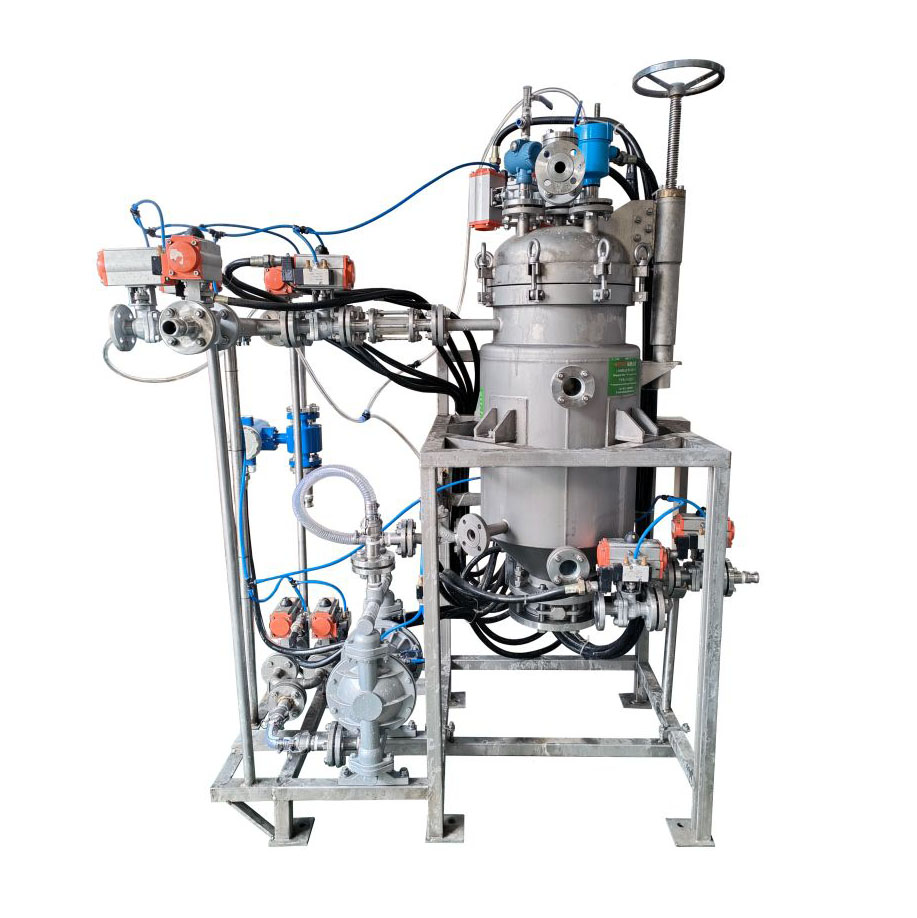
6. How Does VITHY’s VZTF Candle Filter Support Catalyst Recovery?
VITHY’s VZTF Automatic Self-cleaning Candle Filter is designed for industrial applications involving fine solid-liquid separation, filter cake recovery, and automatic cleaning.
Its published application information specifically identifies catalyst recovery within petrochemical and chemical processing applications.
The system integrates multiple filtration elements inside a sealed pressure vessel.
Its operating functions include:
- Direct filtration.
- Pre-coated filtration.
- Slurry concentration.
- Filter cake recovery.
- Filter cake washing.
- Pulse-jet cleaning.
- Automatic solids discharge.
The VZTF product specifications include:
| Technical Parameter | Published Specification |
|---|---|
| Filtration area | 1–200 m² |
| Filtration rating | 1–1000 μm |
| Standard design pressure | 0.6 MPa / 1.0 MPa |
| Higher pressure | Customizable |
| Filter cloth | PP, PET, PPS, PVDF, PTFE, etc. |
| Filter cartridge | SS304, SS316L, FRPP, PVDF |
| Housing materials | SS304, SS316L, SS2205, carbon steel and other options |
| Control system | Siemens PLC |
| Maximum operating temperature | Up to 260°C, depending on configuration |
These figures represent published product ranges. Actual operating limits depend on the selected configuration and the compatibility of all wetted components.
For catalyst recovery, engineers should pay particular attention to filter cloth compatibility, vessel materials, solvent properties, cake discharge characteristics, and the required level of process containment.
VITHY provides application-based model selection according to customer process conditions rather than relying exclusively on nominal filtration area.
7. What Information Should Petrochemical Plants Provide When Requesting a Filtration Solution?
To evaluate a catalyst recovery application, equipment suppliers need sufficient process information.
A technical inquiry should ideally include:
- Catalyst name and chemical composition.
- Catalyst particle-size distribution.
- Catalyst concentration in the liquid.
- Liquid or solvent composition.
- Required processing capacity.
- Operating temperature and pressure.
- Required filtrate quality.
- Target catalyst recovery requirements.
- Required filter cake moisture.
- Whether cake washing or inert gas drying is necessary.
Where possible, representative slurry samples should be provided for laboratory or pilot testing.
These tests can establish filtration flux, cake resistance, washing effectiveness, and discharge characteristics.
They also help identify potential material compatibility issues before final equipment selection.
Frequently Asked Questions
Q1: Can a candle filter recover fine catalyst particles?
Yes. A candle filter can retain fine suspended particles through selected filter media and subsequent filter cake formation. Actual particle retention depends on particle characteristics, media selection, and operating conditions.
Q2: Can recovered catalyst be reused after filtration?
Filtration can separate catalyst solids from process liquids, but it does not automatically restore catalytic activity. Reuse depends on catalyst condition, contamination, deactivation mechanisms, and the requirements of the original process.
Q3: Can catalyst cake be washed inside a candle filter?
Yes. Cake washing can be integrated into the filtration cycle to remove residual mother liquor or soluble impurities. The washing medium and procedure must be compatible with the catalyst and process chemistry.
Q4: Is nitrogen suitable for candle filter backblowing?
Nitrogen may be suitable for applications involving flammable solvents or oxygen-sensitive materials. However, the complete system must be designed for the selected gas, including pressure control, ventilation, and oxygen-deficiency safety measures.
Q5: How can petrochemical plants improve catalyst recovery efficiency?
The main considerations include selecting suitable filter media, optimizing operating pressure, controlling cake thickness, improving cake washing, and minimizing catalyst losses during discharge and handling. Representative filtration tests are recommended before final equipment selection.
Catalyst recovery filtration is an important part of resource management and process quality control in petrochemical plants.
The appropriate filtration system must separate suspended catalyst particles while maintaining acceptable throughput, filtrate quality, cake purity, and operational safety.
Candle filtration offers an integrated approach by combining pressure-driven separation, filter cake formation, optional washing, gas-assisted drying, and automatic solids discharge within an enclosed vessel.
For applications involving fine catalyst particles and recoverable solids, VITHY’s VZTF Automatic Self-cleaning Candle Filter provides a configurable equipment option.
The final design should always be based on actual catalyst characteristics, process chemistry, filtration testing, and plant operating requirements.
Looking for a catalyst recovery filtration solution?
Contact VITHY’s engineering team with your catalyst composition, slurry concentration, particle-size distribution, solvent properties, operating temperature, and required processing capacity.
The engineering team can evaluate the appropriate filtration media, equipment configuration, filtration area, and cake discharge method for your petrochemical application.
Post time: Nov-19-2026


