

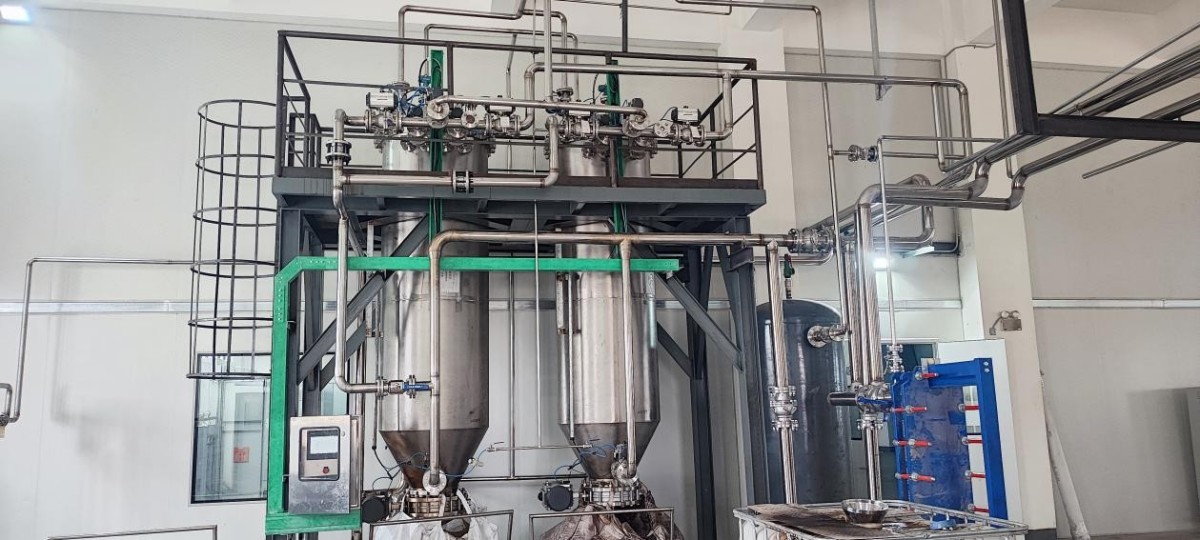
A candle filter can be configured for different particle-retention requirements depending on its filter cloth, support structure, cake formation, and operating conditions. VITHY’s VZTF candle filter has a published filtration rating range of 1–1,000 μm, depending on the selected filter element. However, a stated micron rating should not automatically be interpreted as an absolute particle-removal guarantee.
1. Understanding the Filtration Accuracy of a Candle Filter
The filtration accuracy of a candle filter refers to its ability to retain suspended solid particles while allowing the liquid phase to pass through the filter medium.
Unlike a simple screen that relies mainly on fixed openings, a candle filter can operate through both surface filtration and cake filtration. During operation, particles accumulate on the filter cloth and gradually form a filter cake. As this cake develops, it can become an additional filtration layer capable of retaining particles smaller than those initially captured by the filter cloth.
For industrial buyers, it is important to distinguish three different concepts:
- Filter media rating: The nominal or specified filtration grade of the selected filter cloth or element.
- Particle retention performance: The proportion of particles of a defined size that the filter actually removes.
- Final filtrate quality: The particle concentration, turbidity, or other quality indicators measured downstream.
These three parameters are related, but they are not interchangeable.
For example, selecting a 10 μm filter cloth does not automatically mean that every particle larger than 10 μm will be removed or that every particle smaller than 10 μm will pass through. Actual performance depends on the media structure, particle characteristics, cake development, and process conditions.
Therefore, filtration accuracy should be evaluated against the required downstream process quality rather than relying on a micron number alone.
2. How Does a Candle Filter Capture Fine Particles?
A candle filter generally uses multiple tubular filter elements installed inside a sealed pressure vessel. Each element is covered with filter cloth or another suitable filtration medium.
During filtration, the slurry enters the vessel and flows through the filtration layer. Suspended solids are retained on the outer surface of the filter elements, while the filtrate passes through the media and enters the internal collection channels.
The filtration process can be understood in three stages.
2.1 Initial Filtration: Filter Cloth Retention
At the beginning of a filtration cycle, the filter cloth is the primary filtration barrier.
Its structure, weave, pore distribution, material, and surface characteristics influence the initial particle-retention performance.
For example, different materials such as polypropylene (PP), polyester (PET), PPS, PVDF, and PTFE may be selected according to:
- Particle size and distribution.
- Liquid temperature.
- Chemical compatibility.
- Operating pressure.
- Solids concentration.
- Cleaning and cake-release requirements.
The filter cloth must also provide sufficient mechanical strength and dimensional stability under the intended operating conditions.
2.2 Cake Formation: A Secondary Filtration Layer
As suspended solids accumulate on the filter cloth, they form a filter cake.
This cake becomes an additional filtration medium. Larger particles are often captured closer to the filter cloth, while smaller particles may be retained within the developing cake structure.
The effectiveness of this process depends on the physical properties of the solids.
For example:
- Rigid crystalline particles may form a relatively stable cake.
- Fine mineral particles may produce a dense cake with higher filtration resistance.
- Fibrous materials may create irregular structures and affect filtrate clarity.
- Compressible particles may deform under pressure and reduce cake permeability.
This explains why two slurries with similar particle-size distributions may produce different filtration results.
A properly developed cake can improve fine-particle retention, but excessive cake thickness may increase pressure drop and reduce filtration capacity.

2.3 Cake Discharge and Filter Regeneration
After the filtration cycle reaches its preset pressure or time condition, the system can stop feeding and initiate the cleaning sequence.
Depending on the equipment configuration and process requirements, this may include:
- Stopping slurry feeding.
- Recovering or draining residual liquid.
- Applying compressed air or gas for cake drying, where applicable.
- Using pulse back-blowing or back-flushing to detach accumulated solids.
- Discharging the filter cake through the bottom outlet.
- Preparing the filter elements for the next cycle.
The cleaning process helps restore the filtration surface for subsequent operation.
However, the actual cleaning effectiveness depends on cake adhesion, particle characteristics, cloth selection, and the cleaning parameters.
3. Nominal vs. Absolute Filtration Rating: What Is the Difference?
One of the most common sources of confusion in industrial filtration procurement is the difference between nominal and absolute filtration ratings.
A micron value alone does not fully describe the filtration efficiency of an element.
3.1 Nominal Filtration Rating
A nominal rating generally indicates that a filter removes a stated proportion of particles at or above a specified particle size.
However, the percentage removal and test method may vary between manufacturers.
For example, two filter media products both described as 10 μm nominal may not provide identical particle-retention performance.
The buyer should therefore confirm:
- The particle size used for evaluation.
- The stated removal efficiency.
- The test method.
- Whether the result applies to a clean element or a loaded element.
- The fluid and operating conditions used during testing.
Without these details, nominal ratings are difficult to compare objectively.
3.2 Absolute Filtration Rating
An absolute rating is intended to describe a more stringent particle-retention threshold under defined test conditions.
However, the term is not used consistently across every filtration application or manufacturer.
A supplier should clarify what the term means for the specific product and provide supporting test data.
For critical applications, buyers should avoid accepting an absolute rating as a complete performance specification without knowing the test method, particle challenge, and removal-efficiency criterion.
3.3 Beta Ratio: A More Quantitative Performance Indicator
The Beta ratio provides a quantitative way to describe particle-removal performance at a defined particle size.
It is calculated as:
βx = Number of upstream particles ≥ x μm / Number of downstream particles ≥ x μm
The corresponding removal efficiency is:
Removal Efficiency (%) = (1 − 1/βx) × 100%
For example:
| Beta Ratio | Calculated Removal Efficiency |
|---|---|
| βx = 10 | 90% |
| βx = 20 | 95% |
| βx = 100 | 99% |
| βx = 200 | 99.5% |
| βx = 1,000 | 99.9% |
These are mathematical examples, not guaranteed performance figures for a particular candle filter.
A complete performance statement should identify the particle-size threshold, test method, particle-counting basis, and test conditions.
For a candle filter handling industrial slurry, the buyer should also consider how the cake develops during the filtration cycle. A clean filter cloth and a fully developed filter cake may exhibit different retention characteristics.
4. What Factors Determine the Actual Particle Size a Candle Filter Can Remove?
The actual filtration result is influenced by several interacting factors.
| Key Factor | Influence on Filtration Performance | What Buyers Should Evaluate |
|---|---|---|
| Filter cloth structure | Determines initial particle retention and liquid permeability | Material, weave, pore distribution, and compatibility |
| Particle-size distribution | Influences particle capture and cake structure | D10, D50, D90, and fine-particle content |
| Particle morphology | Affects how particles bridge, orient, and accumulate | Spherical, irregular, fibrous, or plate-like particles |
| Solids concentration | Influences cake formation and filtration-cycle duration | Feed concentration and expected cake loading |
| Liquid viscosity | Affects flow resistance and filtration rate | Operating temperature and liquid viscosity |
| Operating pressure | Provides the driving force for filtration but may compress the cake | Design pressure and operating differential pressure |
| Cake thickness | Influences secondary filtration and pressure drop | Maximum practical cake thickness |
| Cleaning method | Affects residual solids and the next filtration cycle | Back-blowing, back-flushing, and discharge performance |
4.1 Filter Cloth Selection
The filter cloth is the first important component to evaluate.
A finer filtration medium may improve initial particle retention, but it can also increase flow resistance or become more susceptible to blockage.
For this reason, the smallest available micron rating is not necessarily the best selection.
A suitable filter cloth should balance:
- Required filtrate quality.
- Acceptable filtration rate.
- Chemical and temperature resistance.
- Mechanical strength.
- Cake-release characteristics.
- Cleaning and service life.
Material selection is equally important. For example, a cloth suitable for an aqueous mineral slurry may not be appropriate for a hot solvent-based chemical process.
4.2 Particle-Size Distribution and Particle Shape
Particle size should not be evaluated using only the average particle diameter.
A slurry may contain a broad particle-size distribution, including a relatively small proportion of very fine particles.
These fines can influence filtrate quality and may also fill the spaces between larger particles in the cake.
Particle shape is another important variable.
Irregular or fibrous particles may behave differently from rigid spherical particles of the same measured equivalent diameter. Soft particles and gels may also deform under pressure.
For demanding applications, particle-size distribution should be evaluated together with microscopy or other suitable particle-characterization methods.
4.3 Pressure and Cake Compressibility
Increasing filtration pressure can increase the driving force for liquid flow.
However, higher pressure does not always produce a proportionate increase in filtration capacity.
When the solids form a compressible cake, additional pressure may compact the cake and reduce its permeability.
This can result in:
- Higher filtration resistance.
- Reduced filtrate flow.
- Faster pressure buildup.
- More difficult cake discharge in certain applications.
The relationship between pressure and filtration performance should therefore be established through process testing.
5. What Filtration Rating Does the VITHY VZTF Candle Filter Offer?
VITHY’s VZTF Automatic Self-cleaning Candle Filter is designed for industrial solid-liquid separation applications involving high solid content, viscous liquids, high-temperature conditions, and other complex filtration requirements.
According to its published product specifications, the equipment offers the following configuration ranges:
| Parameter | Published VZTF Specification |
|---|---|
| Filtration rating | 1–1,000 μm, depending on the selected filter element |
| Filtration area | 1–200 m² |
| Standard design pressure | 0.6 MPa / 1.0 MPa |
| Higher pressure | Customizable |
| Filter cloth materials | PP, PET, PPS, PVDF, PTFE, etc. |
| Filter cartridge materials | SS304, SS316L, FRPP, PVDF |
| Housing materials | SS304, SS316L, SS2205, carbon steel, and other options |
| Maximum operating temperature | Up to 260°C, depending on configuration |
These are published equipment configuration ranges. They should not be interpreted as proof that every combination of filter material, temperature, pressure, and micron rating is available or suitable for every process.
In particular, the stated 1–1,000 μm filtration rating does not independently establish an absolute removal efficiency at every micron value.
For a specific project, the filter element, filter cloth, operating conditions, and required filtrate quality should be confirmed with the engineering team.

5.1 When Is a Candle Filter Suitable for Fine-Particle Filtration?
A candle filter may be considered when the process requires a combination of solid-liquid separation, cake formation, and enclosed operation.
Typical evaluation scenarios include:
- Chemical slurry filtration.
- Catalyst recovery.
- Pigment and coating material filtration.
- Mineral and inorganic salt processing.
- Process-liquid clarification.
- Industrial wastewater treatment.
The suitability of a candle filter depends on the actual slurry properties and process objectives.
If the application requires extremely low residual particle concentrations, a secondary polishing filter may still be necessary.
For example, a candle filter can be used as the primary solids-removal stage, followed by a cartridge filter to achieve a more stringent downstream cleanliness requirement.
This combined process can help separate bulk solids removal from final polishing rather than forcing one filter to perform both functions.
6. How to Verify Candle Filter Performance Before Purchase
For industrial procurement, filtration accuracy should be verified through a structured evaluation rather than a simple comparison of catalog micron ratings.
A practical evaluation procedure includes the following steps.
Step 1: Define the Required Filtrate Quality
Identify the actual process requirement.
Relevant indicators may include:
- Maximum allowable suspended solids.
- Target particle-size range.
- Turbidity requirement.
- Downstream equipment protection requirements.
- Product-quality specifications.
The target should be expressed in measurable terms whenever possible.
Step 2: Characterize the Feed Slurry
Provide representative process samples or laboratory data.
Important information includes:
- Particle-size distribution.
- Solids concentration.
- Particle morphology.
- Liquid viscosity.
- Operating temperature.
- Chemical composition.
- Expected variation in feed conditions.
This information helps determine whether cake filtration is technically appropriate.
Step 3: Select the Filter Element and Cloth
The supplier should recommend a filter cloth and support structure based on the process conditions.
The selection should consider filtration performance, permeability, chemical compatibility, mechanical strength, and cake-release behavior.
Step 4: Conduct a Filtration Test
Where the required filtrate quality is demanding or the slurry is difficult to characterize, a laboratory or pilot-scale test is recommended.
The test should record:
- Initial and final filtration pressure.
- Filtrate flow rate.
- Filtration time.
- Filtrate solids concentration or particle count.
- Cake thickness and moisture content.
- Cleaning performance.
- Residual solids after discharge.
For particle-removal claims, the test method and particle-counting basis should be documented.
Step 5: Confirm the Complete Operating Cycle
A candle filter should not be evaluated only by the quality of the filtrate during the first minutes of operation.
The evaluation should cover the complete filtration cycle, including cake formation, pressure increase, liquid recovery, cleaning, and solids discharge.
This provides a more realistic basis for estimating production capacity and operating costs.
7. Frequently Asked Questions
Q1: Can a candle filter remove particles smaller than 1 μm?
The actual capability depends on the filter medium, cake characteristics, and operating conditions. Some candle filtration systems can achieve very fine filtration under suitable conditions, but a specific submicron performance claim should be supported by application testing and defined efficiency criteria. VITHY’s published VZTF filtration rating is 1–1,000 μm; this specification should not be interpreted as a guaranteed absolute submicron removal rating.
Q2: Does a 5 μm candle filter remove all particles larger than 5 μm?
Not necessarily. A 5 μm rating alone does not establish 100% removal of all particles at or above that size. Buyers should confirm whether the rating is nominal or absolute, the associated removal efficiency, and the test conditions. A Beta ratio or a documented particle-count test provides a more quantitative basis for evaluating performance.
Q3: Is a finer filter cloth always better?
No. A finer filter cloth may improve initial particle retention, but it can also increase flow resistance, accelerate blockage, and affect filtration-cycle duration. The appropriate selection should balance filtrate quality, processing capacity, cake formation, and cleaning performance.
The particle-removal capability of a candle filter is determined by more than its stated micron rating. Filter cloth structure, particle-size distribution, cake formation, liquid properties, operating pressure, and cleaning conditions all influence the final filtration result.
For industrial buyers, the most reliable approach is to define the required filtrate quality, characterize the feed slurry, select a suitable filter medium, and verify performance through representative testing.
VITHY’s VZTF Automatic Self-cleaning Candle Filter provides a published filtration rating range of 1–1,000 μm, with filter materials and equipment configurations available for different industrial applications. For a specific project, the appropriate configuration should be confirmed through technical evaluation.
Need to evaluate a candle filter for your process? Contact VITHY’s engineering team with your slurry characteristics, target particle size, operating temperature, and required filtrate quality to discuss a suitable filtration solution.
Post time: Nov-19-2026


