

An automatic candle filter discharges filter cake by stopping the feed, removing residual liquid, and introducing a controlled reverse-flow pulse through the filter elements. This pulse detaches solids accumulated on the filter cloth, allowing them to fall into the vessel’s bottom section and exit through a discharge valve. A PLC coordinates the sequence.
1. Why Does a Candle Filter Need an Automatic Cake Discharge System?
During pressure filtration, suspended solids accumulate on the outer surface of the candle filter elements. As filtration continues, these particles form a filter cake.
The cake serves two purposes:
- It retains suspended particles and can contribute to finer solid-liquid separation.
- It stores the separated solids until the filtration cycle is completed.
However, cake accumulation also increases resistance to liquid flow. As the cake becomes thicker, the differential pressure across the filter media and cake generally rises. If the filtration cycle continues beyond the appropriate endpoint, flow may decline and operating conditions may become less stable.
For industrial applications involving high solid loading, valuable recovered solids, or enclosed processing, manually removing the accumulated cake can create additional labor requirements and expose operators to process materials.
An automatic cake discharge system addresses this problem by coordinating filtration termination, residual-liquid removal, cake detachment, and solids discharge.
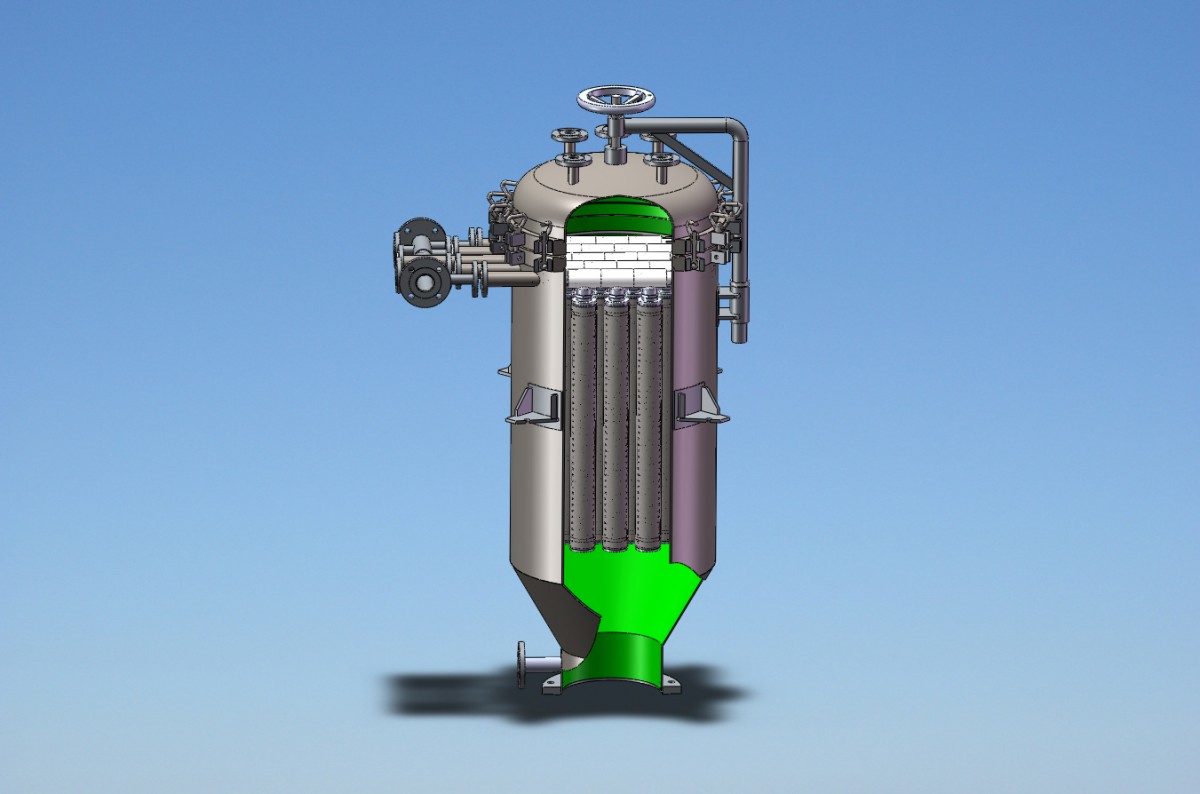
In VITHY’s VZTF Automatic Self-cleaning Candle Filter, this sequence is integrated into a PLC-controlled operating cycle. The system uses pulse-jet backblowing or a selected back-flushing method to remove accumulated impurities from the filter elements. The detached solids then move toward the bottom discharge outlet.
Automatic discharge does not mean that filtration and solids removal occur simultaneously in every configuration. The equipment normally alternates between filtration and cleaning stages according to its control logic.
2. How Does Automatic Filter Cake Discharge Work?
The automatic discharge process can be divided into six main stages.
Stage 1: Filtration and Cake Formation
The slurry enters the sealed filter vessel and flows around the external surfaces of the candle filter elements.
Each element consists of a supporting structure covered with filter cloth. The liquid passes through the filter media and enters the internal channel of the element, while suspended solids remain on the outer surface.
As the retained particles accumulate, a filter cake develops.
The cake thickness and filtration resistance depend on several process variables:
- Suspended solids concentration.
- Particle size distribution.
- Particle shape and surface characteristics.
- Liquid viscosity.
- Cake permeability and compressibility.
- Filtration pressure and operating time.
The control system monitors the relevant operating signals. Depending on the selected configuration, a cleaning cycle may be initiated when a predefined pressure condition or time setting is reached.
Stage 2: Stop Feeding
When the filtration cycle reaches its configured endpoint, the PLC sends a signal to stop slurry feeding.
This is an important transition because the filter should not continue receiving fresh solids while the cleaning sequence is being prepared.
The feed pump or relevant inlet valve is controlled according to the system design.
The exact shutdown logic depends on the process arrangement. For example, a system with a recirculation stage may need to switch the flow path before entering the cleaning sequence.
Stage 3: Drain Residual Liquid
After feeding stops, residual liquid inside the filter vessel needs to be removed through the designated drainage route.
This step reduces the amount of liquid remaining in the vessel before cake detachment and discharge.
The drainage arrangement should be designed around:
- The liquid’s chemical properties.
- The required liquid recovery rate.
- The amount of residual liquid allowed in the discharged solids.
- The downstream collection or recovery system.
- The vessel’s internal geometry and outlet configuration.
For processes involving solvents, corrosive liquids, or valuable process materials, the drainage route should be compatible with the medium and the plant’s containment requirements.
Stage 4: Backblowing or Backflushing
Once the appropriate conditions are established, the system initiates its cleaning operation.
For pulse-jet backblowing, a controlled gas pulse is introduced through the internal side of the filter elements. The reverse flow travels through the filter media and acts on the cake accumulated on the outer surface.
This reverse pressure pulse helps overcome the adhesion and mechanical retention holding the cake against the filter cloth.
As the cake separates, it falls away from the elements toward the bottom of the vessel.
Depending on the application and equipment configuration, the backblowing medium may include:
- Compressed air.
- Nitrogen.
- Saturated steam.
The medium must be selected according to process compatibility, temperature, flammability, oxidation sensitivity, and plant safety requirements.
Backflushing may also be used in configurations designed for liquid-assisted cleaning. It introduces a reverse liquid flow to detach or remove retained material.
Backblowing and backflushing should not be treated as identical operations. Gas-based pulse cleaning and liquid-based reverse washing have different fluid properties and process implications.
Stage 5: Automatic Solids Discharge
After the cake has detached, the solids accumulate in the lower section of the filter vessel.
The PLC then coordinates the opening of the designated discharge valve.
Depending on the equipment design, the bottom valve may use different structures, including cylinder-operated quick-opening arrangements or butterfly valves.
The discharged material can be collected for:
- Catalyst recovery.
- Filter-aid recovery.
- Product or intermediate recovery.
- Waste treatment.
- Further washing or processing.
The discharge system should be designed according to the physical properties of the cake.
For example, a free-flowing powder may behave differently from a wet, cohesive, or sticky cake. The outlet diameter, valve arrangement, vessel geometry, and discharge conditions therefore need to be evaluated together.
Stage 6: Reset and Start the Next Filtration Cycle
After the discharge operation is completed, the system closes the discharge outlet and restores the relevant valves to their filtration positions.
The PLC checks the required operating conditions and prepares the equipment for the next cycle.
If the process requires pre-filtration or pre-coating, the corresponding preparation stage is performed before normal filtration begins.
The equipment then returns to its filtration state.
3. What Are the Key Components of an Automatic Cake Discharge System?
Automatic discharge depends on the coordination of several mechanical, pneumatic, and control components.
| Component | Main Function | Engineering Consideration |
|---|---|---|
| Candle filter elements | Provide the filtration surface and support the filter media | Media selection, mechanical strength, and compatibility |
| Filter cloth | Retains suspended solids and supports cake formation | Material, permeability, particle retention, and temperature resistance |
| Compressed gas or backblowing supply | Provides the reverse-flow pulse for cake detachment | Pressure, pulse duration, gas quality, and process safety |
| Drainage system | Removes residual liquid before discharge | Liquid recovery, drainage capacity, and material compatibility |
| Bottom discharge valve | Releases detached filter cake | Cake flowability, outlet size, and sealing requirements |
| PLC control system | Coordinates the operating sequence | Control logic, interlocks, and operating parameters |
| Pressure transmitter | Provides pressure-related operating signals | Measurement range, accuracy, and maintenance |
| Optional level sensor | Monitors liquid level where required | Installation position and process conditions |
| Optional flowmeter | Measures process flow | Flow range and liquid properties |
VITHY’s VZTF product information identifies Siemens PLC control and lists optional instruments such as pressure transmitters, level sensors, flowmeters, and thermometers.
The final instrumentation package depends on the process requirements. Not every application needs every optional instrument.
4. Backblowing vs. Backflushing: What Is the Difference?
Both methods can be used to remove accumulated material from filter elements, but their operating mechanisms differ.
| Comparison Item | Backblowing | Backflushing |
|---|---|---|
| Cleaning medium | Gas | Liquid |
| Main mechanism | Reverse gas pulse | Reverse liquid flow |
| Typical purpose | Detaching filter cake | Washing or removing retained particles |
| Effect on residual liquid | Can support gas-assisted liquid displacement | Introduces a liquid cleaning medium |
| Process considerations | Gas compatibility, pulse pressure, and safety | Liquid compatibility, drainage, and waste handling |
| Potential applications | Cake discharge and selected dry-solids recovery processes | Selected applications requiring liquid-assisted cleaning |
When Is Backblowing More Suitable?
Backblowing is worth evaluating when:
- A filter cake forms on the outside of the candle elements.
- The cake can be detached by a controlled reverse gas pulse.
- The process requires automatic solids discharge.
- Gas-assisted drying or liquid displacement is beneficial.
- The selected gas is compatible with the process medium and solids.
When Should Backflushing Be Considered?
Backflushing may be considered when:
- The retained material is better removed through liquid-assisted cleaning.
- A suitable washing liquid is available.
- The process can accommodate the additional liquid.
- The cleaning liquid is compatible with the filter media and process materials.
The correct method should be confirmed through process testing. A highly adhesive or compressible cake may not detach effectively under the same conditions as a free-flowing particulate cake.
5. What Factors Affect Automatic Cake Discharge Performance?
Automatic discharge is not determined by pulse pressure alone. Several factors influence whether the cake can separate completely and leave the vessel reliably.
5.1 Filter Cake Properties
Cake properties are among the most important variables.
A relatively permeable cake may allow gas to pass through more easily, while a highly compressible cake may become dense under pressure and resist separation.
Other relevant characteristics include:
- Moisture content.
- Particle size and distribution.
- Particle shape.
- Adhesion to the filter cloth.
- Cake thickness.
- Chemical interaction between the solids and filter media.
Engineers should evaluate the actual slurry rather than assuming that all solids can be discharged using the same cleaning settings.
5.2 Filter Media Selection
The filter cloth influences both filtration and cake release.
Its material, surface characteristics, weave structure, permeability, and compatibility with the process fluid can affect cake formation and detachment.
A filter cloth selected only for particle retention may not necessarily provide the best cake-release performance.
The media should therefore be evaluated against both filtration requirements and cleaning behavior.
5.3 Backblowing Conditions
The backblowing pressure, pulse duration, gas volume, and sequence timing influence the cleaning result.
Insufficient reverse-flow energy may leave residual cake on the filter media.
Excessive or poorly controlled conditions may increase mechanical stress on the filter cloth or supporting structure.
The appropriate settings should be established according to the filter element design and tested process conditions. A higher pulse pressure should not automatically be interpreted as better cleaning.
5.4 Discharge Valve and Vessel Design
Even when the cake has detached successfully, it must still move through the lower section of the vessel and pass through the discharge outlet.
Sticky solids, bridging, or poor flowability can cause discharge problems.
Engineers should consider:
- Cake flow characteristics.
- Vessel bottom geometry.
- Outlet diameter.
- Valve opening arrangement.
- Available discharge time.
- Downstream solids-handling equipment.
5.5 Control Logic and Instrumentation
The PLC must coordinate the transitions between feeding, drainage, cleaning, discharge, and reset.
Incorrect sequencing may lead to incomplete drainage, ineffective cleaning, or premature feeding.
Pressure transmitters and other optional instruments can provide signals for process monitoring and control.
The control strategy should also include appropriate interlocks to prevent unsafe operation, such as opening a discharge valve under unsuitable pressure conditions.
6. What Should Engineers Check If Automatic Cake Discharge Is Incomplete?
If solids remain on the filter elements or do not leave the vessel completely, engineers should investigate the process systematically.
| Observed Symptom | Possible Cause | Recommended Check |
|---|---|---|
| Cake remains attached to filter cloth | Insufficient backblowing effect or strong cake adhesion | Check pulse conditions and cake properties |
| Only part of the cake detaches | Uneven reverse-flow distribution or uneven cake formation | Inspect element arrangement and cleaning distribution |
| Cake detaches but remains inside the vessel | Poor solids flowability or unsuitable vessel-bottom geometry | Inspect the lower vessel section and discharge path |
| Discharge valve does not operate correctly | Actuator, pneumatic supply, or control signal issue | Check valve movement, air supply, and PLC output |
| Cleaning performance gradually declines | Filter cloth fouling or changes in slurry properties | Inspect the media and compare operating trends |
| Filtration cycles become shorter | Increased solids loading, changing feed properties, or higher filtration resistance | Review feed concentration, differential pressure, and cake characteristics |
A practical troubleshooting sequence is:
- Confirm that the feed has stopped as intended.
- Verify that residual liquid has drained through the correct route.
- Check the backblowing or backflushing supply.
- Inspect whether the cleaning pulse is being executed according to the configured sequence.
- Confirm that the discharge valve opens and closes correctly.
- Examine the cake properties and filter media if incomplete discharge continues.
Operators should not attempt to open a pressure vessel or manually remove solids before the equipment has been isolated, depressurized, and made safe according to the plant’s procedures.
7. How Does VITHY’s VZTF Candle Filter Support Automatic Cake Discharge?
VITHY’s VZTF Automatic Self-cleaning Candle Filter is designed to integrate filtration, cleaning, and solids discharge within a sealed pressure vessel.
The product uses multiple porous supporting cartridges covered with filter cloth. During filtration, liquid passes through the filter cloth into the cartridge interior, while suspended solids accumulate on the external surface.
When the configured pressure or time condition is reached, the PLC initiates the cleaning sequence.
The published operating principle includes:
- Stopping slurry feeding.
- Draining residual liquid from the vessel.
- Introducing a pulse of compressed air, nitrogen, or saturated steam for cake detachment, where appropriate.
- Opening the designated discharge outlet.
- Removing the detached solids.
- Closing the outlet and preparing for the next cycle.
The VZTF product also supports several filtration-related functions:
- Direct filtration.
- Pre-coated filtration.
- Slurry concentration.
- Filter cake recovery.
- Filter cake washing.
Published VZTF Technical Specifications
| Parameter | Published Specification |
|---|---|
| Filtration area | 1–200 m²; larger sizes customizable |
| Filtration rating | 1–1000 μm, depending on filter element selection |
| Standard design pressure | 0.6 MPa / 1.0 MPa |
| Higher design pressure | Customizable |
| Filter cloth materials | PP, PET, PPS, PVDF, PTFE, and others |
| Filter cartridge materials | SS304, SS316L, FRPP, PVDF |
| Housing materials | SS304, SS316L, SS2205, carbon steel, lined or coated materials, titanium, and others |
| Control system | Siemens PLC |
| Bottom discharge valve | Cylinder-operated quick-opening type, butterfly valve, and other configurations |
These are published product specifications, not guaranteed performance values for every process.
Actual filtration capacity, cake discharge performance, cycle time, and residual cake quantity depend on the feed composition, cake properties, filter media, operating settings, and equipment configuration.
For a specific application, engineers should evaluate the slurry characteristics and confirm the discharge sequence through appropriate testing.
Frequently Asked Questions
Q1: How does a candle filter remove filter cake automatically?
An automatic candle filter normally stops feeding, drains residual liquid, and introduces a controlled reverse-flow pulse through the filter elements. The pulse detaches the accumulated cake, which falls into the vessel’s lower section and exits through the discharge valve.
Q2: What gas is used for candle filter backblowing?
Compressed air, nitrogen, or saturated steam may be used, depending on the equipment configuration and process requirements. Gas selection must consider chemical compatibility, flammability, oxidation sensitivity, temperature, and plant safety.
Q3: Does automatic cake discharge require manual operation?
The main operating sequence can be controlled automatically through a PLC. However, operators still need to monitor process conditions, inspect equipment, maintain instruments, and perform scheduled maintenance.
Q4: Can a candle filter discharge wet filter cake?
Yes. The discharge system can remove cake with different moisture levels. However, the cake’s flowability and adhesion characteristics affect discharge performance. Gas-assisted drying may be incorporated where the process requires lower residual liquid content.
Q5: Can all types of filter cake be removed by backblowing?
No. Cake properties vary significantly. Highly adhesive, sticky, compressible, or poorly permeable solids may require different media, cleaning conditions, or equipment configurations. Process testing is recommended.
Q6: Is automatic cake discharge the same as continuous filtration?
Not necessarily. Many automatic candle filters operate in repeating filtration and cleaning cycles. Filtration is interrupted during the discharge sequence. Whether the overall production process can maintain continuous downstream supply depends on system design, including the use of multiple units or buffer capacity.
Automatic cake discharge is a coordinated process involving filtration termination, residual-liquid drainage, reverse-flow cleaning, solids release, and vessel reset.
Its effectiveness depends on more than the cleaning pulse. Cake properties, filter media, backblowing conditions, discharge valve design, vessel geometry, and PLC sequencing all influence the result.
For industrial applications requiring enclosed solid-liquid separation and automated solids recovery, an automatic candle filter can integrate these operations into a controlled process cycle.
The most reliable equipment selection approach is to evaluate the actual slurry, define the required cake-discharge conditions, and verify the operating sequence before finalizing the system configuration.
Post time: Nov-23-2026


