

Yes. Candle filter elements are generally designed for repeated filtration cycles rather than disposal after each cycle. In VITHY’s VZTF system, accumulated filter cake is removed through an automatic cleaning and discharge sequence. However, removing the cake does not necessarily restore the filter cloth to its original condition. Reuse depends on media integrity, residual contamination, filtration performance, and compatibility with the cleaning method.
1. Can Candle Filter Elements Be Cleaned and Reused?
In most industrial candle filtration systems, the filter elements are intended to be used repeatedly.
A typical candle filter consists of a supporting cartridge covered with filter cloth or another suitable filtration medium. During filtration, suspended solids accumulate on the outer surface of the media and form a filter cake. After the filtration cycle, the accumulated solids are removed through a designated cleaning and discharge process.
The supporting cartridge and filter media can continue to serve in subsequent cycles if they remain mechanically sound and provide acceptable filtration performance.
However, three different maintenance conditions should be distinguished:
| Maintenance Activity | Main Objective | Typical Action |
|---|---|---|
| Cake removal | Remove accumulated solids after a filtration cycle | Pulse back-blowing or back-flushing |
| Filter media cleaning | Remove residual deposits or particles that remain after cake discharge | Compatible liquid cleaning or another approved cleaning procedure |
| Element inspection and replacement | Identify damaged or deteriorated components | Visual inspection, integrity checks, performance evaluation, and replacement when necessary |
The distinction is important because automatic cake discharge and complete filter media regeneration are not the same process.
For example, a filter may successfully discharge most of its cake while some fine particles remain embedded in the cloth structure. If these deposits accumulate over multiple cycles, filtration resistance may increase and the operating cycle may become shorter.
Therefore, candle filter elements should be evaluated according to their actual condition and filtration performance rather than being reused indefinitely.
2. How Does Automatic Cleaning Work in a Candle Filter?
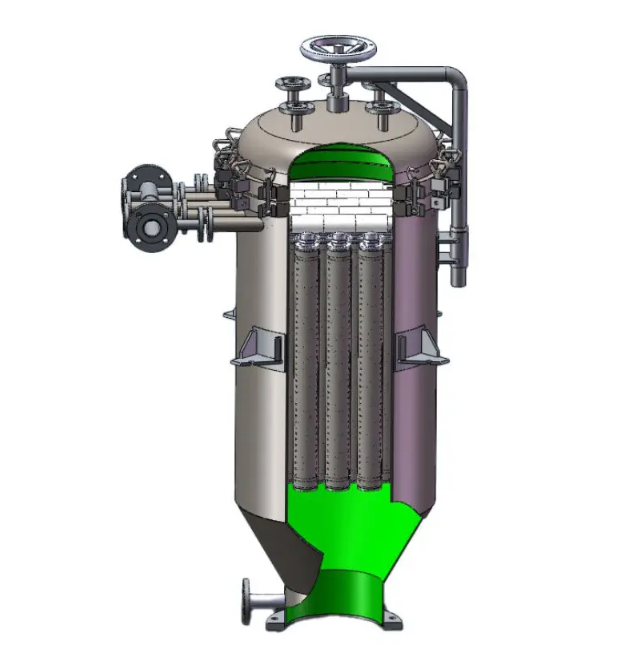
VITHY’s VZTF Automatic Self-cleaning Candle Filter uses multiple porous filter cartridges installed inside a sealed vessel.
The supporting cartridges are covered with filter cloth. During filtration, liquid passes through the cloth and enters the internal passages of the cartridges, while suspended solids accumulate on the outer surface.
According to the published VZTF operating principle, the system uses an automatic sequence to stop feeding, remove residual liquid, detach accumulated solids, and discharge the filter cake.
A typical operating sequence includes the following stages.
Stage 1: Normal Filtration
The slurry enters the filter vessel and passes through the filter cloth.
The liquid phase flows into the internal passages of the filter cartridges and is collected through the filtrate outlet.
Suspended solids remain on the outside of the filter cloth and gradually form a cake layer.
Stage 2: Filtration Termination
When the preset pressure or time condition is reached, the PLC sends a signal to stop feeding.
The filtration cycle ends according to the configured operating logic.
The system then proceeds to the residual-liquid removal and cleaning stages.
Stage 3: Residual-Liquid Removal
Before cake discharge, residual liquid inside the vessel may need to be drained or recovered.
This step helps prepare the filter for the subsequent cleaning sequence.
The appropriate drainage procedure depends on the process configuration and the characteristics of the filtered liquid.
Stage 4: Pulse Back-Blowing or Back-Flushing
VITHY’s VZTF system uses pulse cleaning to detach accumulated solids from the filter elements.
Depending on the configuration, the cleaning medium can include compressed air, nitrogen, or saturated steam. Back-flushing may also be used where appropriate.
The reverse flow or pressure pulse helps separate the filter cake from the filter cloth.
Stage 5: Cake Discharge
After the cake has detached, the accumulated solids are discharged through the designated outlet.
The discharge mechanism and sequence depend on the equipment configuration and the physical properties of the cake.
Stage 6: Preparation for the Next Filtration Cycle
After cleaning and discharge, the system returns to its initial operating state.
The filter elements can continue to be used if the filter cloth, supporting cartridges, seals, and other relevant components remain in acceptable condition.
Important: This automatic cleaning sequence primarily removes accumulated filter cake. It should not be interpreted as a guarantee that every type of embedded contaminant or irreversible blockage will be removed.
3. What Causes Candle Filter Elements to Lose Filtration Performance?
Even when a candle filter is designed for repeated operation, its performance may gradually change.
The most common causes are associated with incomplete cake discharge, residual contamination, media deterioration, and mechanical damage.
3.1 Residual Fine Particles and Filter Cloth Blinding
Fine particles may penetrate or become embedded in the structure of the filter cloth.
If the cleaning sequence cannot remove these particles, they may accumulate over successive filtration cycles.
This condition is commonly described as filter media blinding.
Possible symptoms include:
- Increasing initial differential pressure.
- Lower filtrate flow at comparable operating conditions.
- Shorter filtration cycles.
- More frequent cleaning requirements.
- Increasing difficulty in maintaining the required filtrate quality.
Blinding may be related to particle characteristics, filter cloth structure, cake properties, or unsuitable cleaning conditions.
A more intensive cleaning process is not automatically the correct solution. The cause of the blockage should first be identified.
3.2 Sticky or Difficult-to-Release Filter Cake
Some industrial solids adhere strongly to the filter cloth.
This may occur with:
- Sticky chemical precipitates.
- Resinous materials.
- Fine pigments.
- Certain polymer residues.
- Sludge containing organic matter.
- Solids that become adhesive during drying.
If the cake does not detach completely, residual deposits may remain on the filter surface.
Over time, incomplete discharge can affect the effective filtration area and increase resistance.
For these applications, the filter cloth surface, cake moisture, discharge method, and operating sequence should be evaluated together.
3.3 Chemical or Thermal Degradation of Filter Cloth
Filter cloth materials have different chemical and temperature resistance characteristics.
Long-term exposure to unsuitable process conditions may result in:
- Reduced tensile strength.
- Dimensional changes.
- Surface deterioration.
- Fiber damage.
- Changes in permeability.
- Increased risk of media failure.
For example, a filter cloth that performs well in a neutral aqueous process may not be suitable for a strongly acidic, alkaline, oxidizing, or high-temperature environment.
Cleaning chemicals can also damage the media if their concentration, temperature, or contact time exceeds the material’s compatibility limits.
Therefore, both normal process conditions and cleaning conditions should be considered when evaluating filter cloth service life.
3.4 Mechanical Damage to Filter Elements
The supporting cartridge provides structural support to the filter cloth.
Mechanical damage to the support structure or filter media may affect filtration integrity.
Potential causes include:
- Excessive differential pressure.
- Incorrect installation.
- Improper handling during maintenance.
- Repeated mechanical stress.
- Incompatible cleaning tools.
- Corrosion or erosion.
A damaged filter cloth may allow particles to pass into the filtrate, even when the overall system appears to be operating normally.
For this reason, visual inspection and appropriate integrity checks should be included in maintenance procedures.
4. How Should Candle Filter Elements Be Cleaned?
The cleaning method should be selected according to the type of contamination and the construction of the filter element.
Different cleaning methods address different problems. A method that removes loose surface cake may not remove deposits embedded inside the media.
4.1 Pulse Back-Blowing
Pulse back-blowing uses a reverse gas flow to detach the accumulated filter cake.
For suitable applications, this method can remove cake without requiring the filter elements to be manually dismantled after every cycle.
Potential advantages include:
- Automated operation.
- Reduced manual cake removal.
- Suitable integration with cyclic filtration.
- Support for enclosed solids discharge.
However, its effectiveness depends on cake adhesion, cake moisture, filter cloth flexibility, pulse parameters, and equipment configuration.
It is mainly a cake-discharge method, not a universal solution for chemical deposits or irreversible media blockage.
4.2 Back-Flushing
Back-flushing uses a reverse liquid flow to help remove accumulated particles from the filter medium.
It may be suitable when the process and filter construction allow reverse liquid flow.
The effectiveness depends on:
- Reverse-flow pressure.
- Cleaning liquid properties.
- Particle adhesion.
- Filter cloth structure.
- Contamination location.
- Drainage and waste-liquid handling.
Back-flushing should be carried out within the equipment’s approved operating limits.
4.3 Chemical Cleaning
Chemical cleaning may be considered when deposits cannot be removed effectively through normal cake discharge or back-flushing.
The cleaning solution should be selected according to the chemical composition of the contamination and the compatibility of the filter cloth, cartridge, housing, seals, and other wetted components.
Before applying chemical cleaning, engineers should confirm:
- The identity and solubility of the deposits.
- Chemical compatibility with the filter media.
- Compatibility with the supporting cartridge and seals.
- Suitable concentration and temperature.
- Contact time and rinsing requirements.
- Waste-liquid treatment requirements.
An unsuitable cleaning chemical may damage the filter cloth or create additional process contamination.
Chemical cleaning should therefore follow a validated or manufacturer-approved procedure rather than an improvised cleaning formula.
4.4 Manual Inspection and Cleaning
If the filter elements require removal, maintenance personnel should inspect the cloth and supporting structure for visible damage and residual deposits.
Manual cleaning may be considered for localized contamination, but the method must not damage the filtration surface.
Aggressive scraping, uncontrolled brushing, or excessive-pressure water jets can deform or damage certain filter media.
The appropriate cleaning method should be confirmed for the specific element design.
Cleaning Method Comparison
| Cleaning Method | Main Purpose | Suitable Conditions | Important Limitations |
|---|---|---|---|
| Pulse back-blowing | Detach accumulated cake | Cake can be separated by reverse gas pressure | May not remove embedded particles or chemical deposits |
| Back-flushing | Remove loose particles through reverse liquid flow | Media and system allow reverse liquid cleaning | Depends on reverse-flow conditions and contaminant properties |
| Chemical cleaning | Dissolve or loosen persistent deposits | Deposits are chemically removable and materials are compatible | Incorrect chemistry may damage media or seals |
| Manual cleaning | Inspect and address localized deposits | Element removal is permitted and contamination is accessible | Requires careful handling and inspection |
| Element replacement | Restore filtration integrity when media is no longer serviceable | Damaged, degraded, or irreversibly blocked elements | Requires compatible replacement components |
5. How to Determine Whether a Candle Filter Element Can Be Reused
A candle filter element should not be returned to service based only on its external appearance.
The decision should consider mechanical integrity and actual filtration performance.
The following inspection procedure can help maintenance teams evaluate element condition.
Step 1: Inspect the Filter Cloth
Check for:
- Tears or holes.
- Abrasion.
- Loose seams.
- Deformation.
- Discoloration or chemical attack.
- Persistent deposits.
- Damaged attachment points.
Any visible damage that may compromise filtration integrity should be investigated before reuse.
Step 2: Inspect the Supporting Cartridge
The supporting structure should be checked for:
- Deformation.
- Corrosion.
- Cracks.
- Damaged connections.
- Blocked internal passages.
- Loose or damaged fittings.
The cartridge must maintain adequate mechanical support for the filter cloth under the intended operating conditions.
Step 3: Review Differential Pressure Trends
Compare the initial differential pressure after cleaning with the established clean or acceptable operating baseline.
A consistently increasing starting differential pressure may indicate incomplete cleaning, residual deposits, or progressive media blockage.
It is important to compare data under similar operating conditions, including liquid viscosity, temperature, and flow requirements.
Step 4: Verify Filtration Performance
After cleaning, conduct a controlled operating check.
Evaluate:
- Initial filtrate flow.
- Differential pressure.
- Filtrate quality.
- Pressure increase over time.
- Filtration-cycle duration.
If the element cannot meet the required process performance, further cleaning or replacement should be considered.
Step 5: Record the Maintenance Result
Maintenance records should include the cleaning method, observed damage, operating data, and final reuse decision.
This helps identify gradual deterioration and establish a practical maintenance schedule.
6. Candle Filter Element Inspection Checklist
The following table can be used as a preliminary maintenance checklist.
| Inspection Item | What to Check | Acceptable Condition | Recommended Action if Abnormal |
|---|---|---|---|
| Filter cloth surface | Tears, holes, abrasion, deformation | No visible damage affecting filtration integrity | Repair only if approved, otherwise replace |
| Filter cloth cleanliness | Residual deposits and blockage | Cleaning restores acceptable filtration performance | Investigate contamination and select an approved cleaning method |
| Cartridge structure | Corrosion, deformation, cracks | Structurally sound | Repair or replace according to engineering assessment |
| Element connections | Loose fittings or damaged attachment points | Secure and correctly installed | Reinstall or replace damaged components |
| Initial differential pressure | Pressure after cleaning | Within the established operating baseline | Investigate incomplete cleaning or blockage |
| Filtrate quality | Suspended solids or particle breakthrough | Meets process requirements | Inspect media integrity and filtration configuration |
| Filtration cycle time | Changes between comparable cycles | Consistent with the established operating range | Review solids loading, viscosity, pressure, and media condition |
| Cake discharge | Residual cake after cleaning | Discharge is sufficiently complete for the next cycle | Review cake properties and cleaning parameters |
| Seals and gaskets | Leakage, hardening, deformation | Suitable for the process and operating conditions | Replace with compatible components |
The acceptance criteria should be defined by the equipment manufacturer and the user’s process requirements.
A checklist is useful for routine inspection, but it does not replace pressure-vessel maintenance procedures, safety requirements, or formal element integrity testing where required.
7. When Should Candle Filter Elements Be Replaced?
Cleaning and reuse are practical only while the element remains suitable for the process.
Replacement should be considered when cleaning no longer restores acceptable performance or when mechanical integrity is compromised.
Typical replacement conditions include:
- Filter cloth tears or holes.
- Persistent particle breakthrough.
- Irreversible blockage.
- Chemical degradation.
- Excessive wear or deformation.
- Damaged cartridge support.
- Repeated failure to meet filtration requirements after approved cleaning.
The supporting cartridge and filter cloth should be evaluated separately.
In some designs, the supporting cartridge may remain serviceable while the filter cloth requires replacement. In other cases, damage to the support structure may require replacement of the complete assembly.
The actual replacement procedure depends on the filter element construction and manufacturer instructions.
7.1 How to Reduce Unnecessary Filter Element Replacement
A practical maintenance strategy should focus on preventing avoidable damage and identifying performance deterioration early.
Recommended measures include:
- Select filter cloth materials compatible with the process liquid.
- Avoid operating beyond the approved pressure and temperature limits.
- Monitor differential pressure and filtration-cycle trends.
- Confirm that cake discharge is sufficiently complete.
- Use only approved cleaning procedures.
- Inspect the filter cloth and supporting cartridge periodically.
- Maintain records of cleaning, inspection, and replacement.
These measures can help maintenance teams distinguish between normal cake accumulation and progressive filter media deterioration.
8. Frequently Asked Questions
Q1: Can candle filter elements be reused after every filtration cycle?
In general, yes. Industrial candle filter systems are commonly designed for repeated operation. In VITHY’s VZTF system, accumulated filter cake is removed through an automatic cleaning and discharge sequence. However, the filter cloth and supporting cartridge must remain in acceptable condition for continued use.
Q2: Does automatic back-blowing completely clean the filter cloth?
Not necessarily. Back-blowing is primarily intended to detach accumulated filter cake. Fine particles embedded in the filter cloth or chemically bonded deposits may remain after the cleaning cycle. Additional cleaning or element replacement may be required depending on the contamination.
Q3: How can operators identify a blocked candle filter element?
Common indicators include increasing initial differential pressure, declining filtrate flow, shorter filtration cycles, and deterioration in filtrate quality. These symptoms should be evaluated together because they can also result from changes in slurry concentration, viscosity, or particle-size distribution.
Q4: Can chemical cleaning extend filter cloth service life?
It may help remove deposits that cannot be removed through normal cake discharge. However, the cleaning chemicals must be compatible with the filter cloth, cartridge, seals, and process requirements. Improper chemical cleaning can accelerate material deterioration.
Q5: When should a candle filter element be replaced instead of cleaned?
Replacement should be considered when the media is damaged, chemically degraded, irreversibly blocked, or unable to meet the required filtration performance after an approved cleaning procedure. The decision should be based on inspection and operating data rather than an assumed fixed service life.
Conclusion
Candle filter elements are generally designed for repeated industrial filtration cycles. Automatic cake discharge through pulse back-blowing or back-flushing can reduce the need for manual cleaning after each cycle.
However, removing the accumulated cake does not guarantee complete restoration of the filter cloth. Residual particles, chemical deposits, mechanical damage, and material deterioration can gradually affect filtration performance.
A reliable maintenance strategy should combine automatic cake removal, periodic filter media inspection, differential pressure monitoring, filtration performance checks, and compatible cleaning procedures.
VITHY’s VZTF Automatic Self-cleaning Candle Filter uses a programmed cleaning and discharge sequence to support repeated filtration operation. Whether an element can continue to be reused depends on its actual condition and the requirements of the application.
Need technical support for candle filter cleaning or element replacement? Contact VITHY’s engineering team with your filter model, process liquid, solids characteristics, operating pressure, and current filtration symptoms to discuss an appropriate maintenance approach.
Post time: Nov-23-2026


